Once upon a time ... I was a budding but green economic geologist of the hard rock kind (I'm no longer green or budding, but otherwise the same). It was an era when many mineral exploration companies and related outfits looked to hire graduates who had recently completed their Master's degree in geology, a time when summer jobs (not internships as they seem to now be called) were often available to M.S. students prior to graduation, and a time when some summer jobs were available for geologists still working on their Bachelor's degrees. A solid background in mineralogy, petrography, structure, and completion of field camp were usually expected, and for "real" jobs (the so-called full-time jobs, permanent or semi-permanent, which eventually led to variable benefits), it was expected that your graduate degree had focused on hard rock geology of some kind, with a thesis centered around some economic problem—the mapping of a mining district being one classic type of thesis that companies looked for and encouraged (and sometimes funded).
Never mind your background and degrees, however, one could still expect to do some kind of fairly basic field work for one's first summer or two—or even for many of the early years—the details of that work depending on your aptitude, the availability of more creative or responsible assignments (and the possibility of designing self-generated exploration programs), and the type of on-the-job training you might get (or not get). Because we all came from hard rock and mineral-exploration–oriented backgrounds, companies and bosses expected us to want to go out and find something (a gold or moly deposit or prospect, for example), and companies and bosses expected us to be enthusiastic about getting out there and doing it, despite the long hours, hard work, variable to poor accomodations, and generally poor connections to what might have been our home life, if we had managed to create one while in grad school. It was a work-hard–play-hard sort of ethic, one left over from field camp, one that stayed with many of us through the long years. In recompense, you got paid somewhere between one half and two thirds of what petroleum companies were paying M.S. grads, and you got to see lots of new countryside (the Brooks Range in Alaska was quite popular for a couple-three years), and you probably would get some serious 4WD experience and maybe even learn a few basics of helicopter flight (which you would hopefully never have to use).
For my first field job, a summer job, I collected stream sediment and water samples across a good portion of central Nevada. I worked for a young woman younger than my then 25 years; I did most of the navigating, she did most of the driving.
For my second field job, a summer job that ended up lasting four years, with one-year renewals every winter, I was given a hand sample test as part of my interview, an interview conducted by at least two, if not three or four, male geologists who were perhaps mostly in their late twenties to possibly mid-thirties.
After being hired, I was, as I've mentioned before, almost immediately sent out to a semi-remote helicopter camp (town was only a few miles of pavement away, but town was small, and we were all a long way from home, with the company offering transportation and accomodations on days off to whatever "larger" town was nearby*). Our primary job was to collect numerous stream sediment samples and the occasional rock sample on daily traverses down 3 to 5 mile drainages, while also taking scintillometer readings along the way and at sample sites. We worked in 4-man crews (2 women, 2 men in my camp—plus camp cook, a helicopter pilot and fuel truck driver shared between two camps, and an occasional boss). We were fortunate to do some on-the-ground geologic mapping in four areas staked by the company during the course of, and as a result of, our summer explorations.
I hired my own field assistants/partners from 1981 through about 1991, usually one per summer or year, sometimes with jobs lasting as long as two years. I unabashedly practised reverse discrimination as much as possible: looking around, I could see that if I didn't hire women, none or very few would get hired. I rarely ended up hiring someone who didn't know basic rocks and minerals. In fact, the young geologists I interviewed, my age to a few years younger than me, often knew more than the basics, and they usually knew the basics quite well. Some were mineralogical hot shots; others were strong in geochemistry. I would often have to teach sampling methods and what in particular to look for; this basic exploration introduction was often accomplished by an early season field trip designed to see mineralized areas of interest, whether or not those areas were held under claim by us or by others (the latter would, of necessity, involve some stealth operations). My favorite place to go for this recon intro was Yuma, where we could always get good food and pitchers of margaritas (stories of Yuma not yet told).
Because of the orientation of geologists coming in to interview, and the orientation of schools we sometimes recruited at, I rarely had to work with young geologists who had no, or little, interest in the work we would set out to do every morning. I had one or two field assistants who were rather lackluster, maybe showing little inclination to learn the terminology of the field or to put in the required hours of throwing drilling samples into the back of my truck, only to lug them once again from the bed of the pickup to the sample trailer—but I've been lucky and have rarely run across these lackluster types. At least once I was at fault for hiring the wrong person (choosing the right people hasn't always been easy for me, and at least once, with the company refusing to match the going summer rate during the slowdown of the late 80s, the best candidate got away to some worthy competitor, maybe Freeport or Newmont). At least one of the lackluster types was hired by someone else for later in the season, with me being stuck with that person until my temp showed up later in the year. (At Northern Exploration Company, our summer geologists were called "summer hires" or "summer" somethings; at Former Mining Company, we called them "temps," an epithet I gradually adjusted to and finally used.)
During my own slowdown years (and perhaps the trend had already started sometime during the 80s), it gradually came to pass that geologists with solid hard rock basics and Master's degrees became unavailable or less and less abundant, schools changed directions and dropped mining-related degrees and course work, and some schools eventually ran out if funding for field trips and field camps while basic on-campus field methods classes fell by the wayside. Some Schools of Mines became Schools of Earth Sciences. And so it went...
---
* On my first days off, because I refused to be shipped off to the larger town of Las Vegas (at only 4 years in Nevada, I was already a die-hard, not interested in casinos or glitz), I stayed in camp, driving a company truck up to Wheeler Peak one day, and driving around the Caliente area on other days. We had three days off for every 11 worked (that, by the way, fully identifies "Northern Exploration Company" to those in the know).
Showing posts with label ramble. Show all posts
Showing posts with label ramble. Show all posts
Monday, July 4, 2011


Sunday, June 26, 2011
The Weekend Effect
It's the weekend, and not much has been going on at work, which is why weekends are nice. The weekly crowd leaves, has days off, and it's oh, so quiet. Very few emails are sent down the pike on a weekend, very few phone calls come in.
It doesn't matter whether I'm even there or not: no emails, no phone calls, no voice messages. :)
If one is in the field, actually out hiking around, mapping, taking samples, checking out localities, even driving to drill rigs, the weekend effect is still noticeable. These days, people generally assume that you can be reached by cell phone and email, even when you are in the field concentrating on rocks. Consequently, they call you, email you, leave messages, possibly bugging the hell out of you while you are trying to get things done, trying to have some peace, trying to commune with the rocks (perhaps non-geologists won't understand the "commune with rocks" aspect of the job). I don't usually see these messages (and I don't always hear my phone, especially if I'm at a rig or am banging away emphatically on some recalcitrant outcrop) — until lunch, when I sit down on a rock, or on the ground leaning against an outcrop or my backpack if a suitable sitting rock is not handy. I can then check my phone for emails, missed calls, phone messages — providing that I'm within range, which is not always the case in Nevada. (Thankfully.) In other words, the weekend effect is still in place when I'm out in the field: I'm unlikely to get any field-disturbing interruptions because the weekday crowd is off work, not around.
I'm not sure if the younger generations** realize, what with all the connectivity of today, that many of us got into geology for the solitude and great outdoor getaways — not just for the opportunity to work at scenic, possibly remote field sites, but also for the resulting benefit of getting away from people, from offices, from everything. We didn't get into it to sit behind computers* looking at simulations of rocks and their rocky relationships; we got into it to get out there and actually see, bang on, and map the rocks. (Many of us did, anyway.) I know geologists who are still moderately uncomfortable with computers, and some who've grown into them over the years, gradually and painstakingly. I know geologists who, if they are ever in the office or at home for more than a week or two, just go stark raving nuts and have to leave: they need to get out and get away from offices, bosses, memos, house and home and all that entails — and now, with constant connectivity, they need to get away from emails, cell phones, voice messages, text messages, and the constant on-call nature that these things are bringing to the field geologist who happens to own a cell phone. (I do know at least one geologist who doesn't own a cell phone; I know others who only use them while on the job; I know one or two who never answer, letting all calls ring through to voice mail.) I (fortunately?) can't always hear my cell phone, even if I have it turned to the max. My loss of hearing is the result of being around drill rigs before ear plugs were de rigueur, and from driving down dirt roads with the side window open. My job has given me relief from the current on-call nature of the job.
Anyway, I hope it's a good weekend for you, wherever you happen to be. Me? I've been weeding the garden and will later have a beer — indoors, away from the skeeters.
---
P.S. This same weekend effect can be created — to some degree, and in some places — by working on holidays, although 3-day weekends in the Mojave and some other field locales can be an absolute drag (to say the least).
---
* I have nothing against computers (as you might have guessed), and I did own the first IBM-compatible portable computer — the giant, 28-lb Compaq, which could barely be crammed into the overhead compartment for airline travel — but when I got into geology, the closest one could get to a computer was the batch room, where one could turn in stacks of punch cards. The associated keypunch and printout rooms were located part way across campus, miles, it seemed from the batch room. Consequently, most students never saw the mainframe, which was hidden away somewhere, maybe in the closed area behind the batch room attendant, who was possibly a computer science major making a few bucks.
** Updated: I hope it's understood that I have nothing against any of the younger generations, but want to merely note some differences between now and back then. When I first went out into the field, if anyone wanted to get in touch with me, they had to get in a 4WD and drive many miles from any town, or they had to rent a light plane or helicopter and fly out, or - never done - they had to get on a horse and ride out to see me. A more normal practice was for me to drive 10 to 30 miles after a day of field work to call the office from a pay phone, or, if I was too far out, to see my boss back in the office 10 days down the line.
For many years, we saw very few young geologists coming into mininig and minerals exploration, so few that I can probably count the ones I know of now middle years on two hands. The severe lack of younger geologists, who would now be in their twenties or early thirties, was lamented quite frequently by my collegues and I. More recently, in the last 5 years in particular, I have met several fine and enthusiastic younger geologists in meetings, working at remote mines, and on geology field trips. I've also met a lot of geologists of varying ages and broadly divergent fields online through blogging and other related activities.
And maybe I have an unusual point of view, having done most of my work in Nevada and other relatively remote parts of the west, where some cell companies can't, today, provide reliable service even 10 miles from our smaller towns or 10 to 30 miles off our major highways.
It doesn't matter whether I'm even there or not: no emails, no phone calls, no voice messages. :)
If one is in the field, actually out hiking around, mapping, taking samples, checking out localities, even driving to drill rigs, the weekend effect is still noticeable. These days, people generally assume that you can be reached by cell phone and email, even when you are in the field concentrating on rocks. Consequently, they call you, email you, leave messages, possibly bugging the hell out of you while you are trying to get things done, trying to have some peace, trying to commune with the rocks (perhaps non-geologists won't understand the "commune with rocks" aspect of the job). I don't usually see these messages (and I don't always hear my phone, especially if I'm at a rig or am banging away emphatically on some recalcitrant outcrop) — until lunch, when I sit down on a rock, or on the ground leaning against an outcrop or my backpack if a suitable sitting rock is not handy. I can then check my phone for emails, missed calls, phone messages — providing that I'm within range, which is not always the case in Nevada. (Thankfully.) In other words, the weekend effect is still in place when I'm out in the field: I'm unlikely to get any field-disturbing interruptions because the weekday crowd is off work, not around.
I'm not sure if the younger generations** realize, what with all the connectivity of today, that many of us got into geology for the solitude and great outdoor getaways — not just for the opportunity to work at scenic, possibly remote field sites, but also for the resulting benefit of getting away from people, from offices, from everything. We didn't get into it to sit behind computers* looking at simulations of rocks and their rocky relationships; we got into it to get out there and actually see, bang on, and map the rocks. (Many of us did, anyway.) I know geologists who are still moderately uncomfortable with computers, and some who've grown into them over the years, gradually and painstakingly. I know geologists who, if they are ever in the office or at home for more than a week or two, just go stark raving nuts and have to leave: they need to get out and get away from offices, bosses, memos, house and home and all that entails — and now, with constant connectivity, they need to get away from emails, cell phones, voice messages, text messages, and the constant on-call nature that these things are bringing to the field geologist who happens to own a cell phone. (I do know at least one geologist who doesn't own a cell phone; I know others who only use them while on the job; I know one or two who never answer, letting all calls ring through to voice mail.) I (fortunately?) can't always hear my cell phone, even if I have it turned to the max. My loss of hearing is the result of being around drill rigs before ear plugs were de rigueur, and from driving down dirt roads with the side window open. My job has given me relief from the current on-call nature of the job.
Anyway, I hope it's a good weekend for you, wherever you happen to be. Me? I've been weeding the garden and will later have a beer — indoors, away from the skeeters.
---
P.S. This same weekend effect can be created — to some degree, and in some places — by working on holidays, although 3-day weekends in the Mojave and some other field locales can be an absolute drag (to say the least).
---
* I have nothing against computers (as you might have guessed), and I did own the first IBM-compatible portable computer — the giant, 28-lb Compaq, which could barely be crammed into the overhead compartment for airline travel — but when I got into geology, the closest one could get to a computer was the batch room, where one could turn in stacks of punch cards. The associated keypunch and printout rooms were located part way across campus, miles, it seemed from the batch room. Consequently, most students never saw the mainframe, which was hidden away somewhere, maybe in the closed area behind the batch room attendant, who was possibly a computer science major making a few bucks.
** Updated: I hope it's understood that I have nothing against any of the younger generations, but want to merely note some differences between now and back then. When I first went out into the field, if anyone wanted to get in touch with me, they had to get in a 4WD and drive many miles from any town, or they had to rent a light plane or helicopter and fly out, or - never done - they had to get on a horse and ride out to see me. A more normal practice was for me to drive 10 to 30 miles after a day of field work to call the office from a pay phone, or, if I was too far out, to see my boss back in the office 10 days down the line.
For many years, we saw very few young geologists coming into mininig and minerals exploration, so few that I can probably count the ones I know of now middle years on two hands. The severe lack of younger geologists, who would now be in their twenties or early thirties, was lamented quite frequently by my collegues and I. More recently, in the last 5 years in particular, I have met several fine and enthusiastic younger geologists in meetings, working at remote mines, and on geology field trips. I've also met a lot of geologists of varying ages and broadly divergent fields online through blogging and other related activities.
And maybe I have an unusual point of view, having done most of my work in Nevada and other relatively remote parts of the west, where some cell companies can't, today, provide reliable service even 10 miles from our smaller towns or 10 to 30 miles off our major highways.
Saturday, November 14, 2009
Late Night Ramblings: From Becke Lines to Mining Scams
Poetic. It's not that I'm feeling poetic, but that word came to mind, so I wrote it down.
I've had the jimmy legs while trying to sleep, so I've opened the window a crack and am drinking a cold dPf while writing in my journal. I'm using a headlamp with a red LED - this has the odd effect of giving the shadow of my moving pen a deep turquoise line on the left side (toward the light) and a deep red line on the right side (away from the light and more or less behind my hand). These colors, and their arrangement around the edges of my pen and hand, remind me first of Becke lines, which surround mineral grains immersed in oils or epoxy media. Then - especially when I turn the pages of this spiral journal - they remind me of 3-D glasses, as if I've somehow entered some supra-dimensional movie. I haven't, though, I'm just writing and wondering where the one-day-late snow is, and whether I have the window cracked too far open for comfort.
(The deep turquoise and deep red lines - which may entirely be optical effects inside my eyes, as I can only see them when the pen shadow or journal moves - has the effect of making this red-lit white paper appear pink to orange to occasionally yellow. It's as though my eyes are trying to convince my brain that I'm using ordinary incandescent lighting.)
And that reminds me - didn't some country just recently outlaw incandescent bulbs? (Actually, several have.) If only the other bulbs worked consistently. I try to buy the most expensive ones in hopes that they will turn out to be the best ones. Hopefully there is enough "byproduct"mercury from the gold mines of the world so we won't have to go back to mining mercury at mercury mines - such as the ones in Spain and Slovenia (Almadén, Idrija) and the ones in the Coast Ranges of California (New Almadén, New Idria). Seeing liquid mercury drip from old trench and pit exposures is something I'd rather not see every day. And, likewise, running across old-looking but still-in-use jars of mercury used for gold extraction by old-timers - whether in some out-of-the-way prospect north of Napa Valley or down some dusty dirt road in the Mojave Desert - is not something I like to come upon unawares or unexpectedly.
The old-timers in question (some of them are still around, perhaps?) are always quite casual about showing you their gold-rich mercury, and they are equally casual about showing you their dusty, disorganized assay labs out in the middle of nowhere. Jars, bottles, and tools of all sorts are scattered on old wooden work benches built against walls - these are their lab tables. From one etched, north-facing window, you have a nice view of the creosote desert and rocky granitic mountains. Want to have lunch in here? (I think not.) And is that an ice chest I see over near the doorway to the main cabin? Yes, the garage-shed assay-lab is attached to the living area of this old field shack. Too many rusted and broken parts, too much dust, and too many old and unknown lab chemicals are lying around loose.
Where did you say you're getting the gold from? Those pinkish brown, fractured granites over there, the ones with the narrow seams of goethitic iron-oxides in either brown carbonate or microcrystalline silica? Veins, you call them? I think I'd be being generous if I called them veinlets. Okay, we'll high-grade just those tiny veinlets, and then we'll see. We'll get back to you after our commercial lab does its thing. (No, you can't do the assays for us. We're already thinking that you got the gold the same place you bought the mercury - maybe in some old Mother Lode mining town?) Maybe we'll be back, and maybe we won't - but no, we won't be looking at your lab anymore, no matter how proud you are of it.
Not to be disparaging about your claims, but though the ankeritic-goethitic veinlets are interesting, they look too narrow and mostly too far apart to be likely to carry the barren granite they're cutting. (Although it's true, they could indicate something at depth, or something underneath that shallow alluvium just over there, right off your claims. But don't worry, we'll still want to lease your claims - if there is anything we want to come back to after we see some real assay numbers.)
(Besides which, old Joe up the road apiece - quite apiece at that - warned us that you were running some kind of scam down here. But maybe he just wants us to lease his claims, not yours. So, we'll see.)
And who was I with, down there in the east-central Mojave? Seems it was in the same area where a small gold mine was operating - the mine that routinely over-loaded their blast holes such that the metal roof of their mine office had dents and holes from large rocks that fell out of the sky every day, rocks blasted out of their small open pit. We ate lunch near the buses, that field trip day, then drove an entire mile away to avoid the coming bombardment.
I don't know what year it was. The location suggests to me that I was there with either PB or NJ - although the sampling part could have been a joint effort with BS and an assistant of his - except I don't think we worked that area with double partners. So the answer may be forever lost in the dirt and dust of that messy lab or in the steep and rocky slopes two canyons over.
Could I find that mine shack again? Maybe. I have a geographic location tucked firmly away in my head - it's a little SSW of that small gold mine, down some wide southerly-heading dirt road, generally SE of that broad, alluvial-choked peak, and in some vague area between or amongst two north-south-trending ranges. Besides which, unless it was on a tiny piece of private land, it's probably gone.
From 12Nov09, 9:33pm
I've had the jimmy legs while trying to sleep, so I've opened the window a crack and am drinking a cold dPf while writing in my journal. I'm using a headlamp with a red LED - this has the odd effect of giving the shadow of my moving pen a deep turquoise line on the left side (toward the light) and a deep red line on the right side (away from the light and more or less behind my hand). These colors, and their arrangement around the edges of my pen and hand, remind me first of Becke lines, which surround mineral grains immersed in oils or epoxy media. Then - especially when I turn the pages of this spiral journal - they remind me of 3-D glasses, as if I've somehow entered some supra-dimensional movie. I haven't, though, I'm just writing and wondering where the one-day-late snow is, and whether I have the window cracked too far open for comfort.
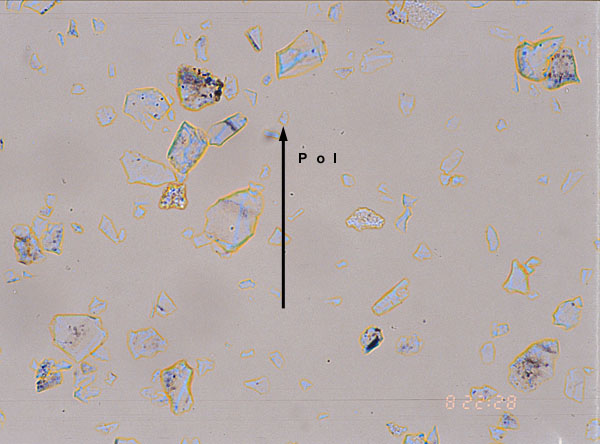
(The deep turquoise and deep red lines - which may entirely be optical effects inside my eyes, as I can only see them when the pen shadow or journal moves - has the effect of making this red-lit white paper appear pink to orange to occasionally yellow. It's as though my eyes are trying to convince my brain that I'm using ordinary incandescent lighting.)
And that reminds me - didn't some country just recently outlaw incandescent bulbs? (Actually, several have.) If only the other bulbs worked consistently. I try to buy the most expensive ones in hopes that they will turn out to be the best ones. Hopefully there is enough "byproduct"mercury from the gold mines of the world so we won't have to go back to mining mercury at mercury mines - such as the ones in Spain and Slovenia (Almadén, Idrija) and the ones in the Coast Ranges of California (New Almadén, New Idria). Seeing liquid mercury drip from old trench and pit exposures is something I'd rather not see every day. And, likewise, running across old-looking but still-in-use jars of mercury used for gold extraction by old-timers - whether in some out-of-the-way prospect north of Napa Valley or down some dusty dirt road in the Mojave Desert - is not something I like to come upon unawares or unexpectedly.
The old-timers in question (some of them are still around, perhaps?) are always quite casual about showing you their gold-rich mercury, and they are equally casual about showing you their dusty, disorganized assay labs out in the middle of nowhere. Jars, bottles, and tools of all sorts are scattered on old wooden work benches built against walls - these are their lab tables. From one etched, north-facing window, you have a nice view of the creosote desert and rocky granitic mountains. Want to have lunch in here? (I think not.) And is that an ice chest I see over near the doorway to the main cabin? Yes, the garage-shed assay-lab is attached to the living area of this old field shack. Too many rusted and broken parts, too much dust, and too many old and unknown lab chemicals are lying around loose.
Where did you say you're getting the gold from? Those pinkish brown, fractured granites over there, the ones with the narrow seams of goethitic iron-oxides in either brown carbonate or microcrystalline silica? Veins, you call them? I think I'd be being generous if I called them veinlets. Okay, we'll high-grade just those tiny veinlets, and then we'll see. We'll get back to you after our commercial lab does its thing. (No, you can't do the assays for us. We're already thinking that you got the gold the same place you bought the mercury - maybe in some old Mother Lode mining town?) Maybe we'll be back, and maybe we won't - but no, we won't be looking at your lab anymore, no matter how proud you are of it.
Not to be disparaging about your claims, but though the ankeritic-goethitic veinlets are interesting, they look too narrow and mostly too far apart to be likely to carry the barren granite they're cutting. (Although it's true, they could indicate something at depth, or something underneath that shallow alluvium just over there, right off your claims. But don't worry, we'll still want to lease your claims - if there is anything we want to come back to after we see some real assay numbers.)
(Besides which, old Joe up the road apiece - quite apiece at that - warned us that you were running some kind of scam down here. But maybe he just wants us to lease his claims, not yours. So, we'll see.)
And who was I with, down there in the east-central Mojave? Seems it was in the same area where a small gold mine was operating - the mine that routinely over-loaded their blast holes such that the metal roof of their mine office had dents and holes from large rocks that fell out of the sky every day, rocks blasted out of their small open pit. We ate lunch near the buses, that field trip day, then drove an entire mile away to avoid the coming bombardment.
I don't know what year it was. The location suggests to me that I was there with either PB or NJ - although the sampling part could have been a joint effort with BS and an assistant of his - except I don't think we worked that area with double partners. So the answer may be forever lost in the dirt and dust of that messy lab or in the steep and rocky slopes two canyons over.
Could I find that mine shack again? Maybe. I have a geographic location tucked firmly away in my head - it's a little SSW of that small gold mine, down some wide southerly-heading dirt road, generally SE of that broad, alluvial-choked peak, and in some vague area between or amongst two north-south-trending ranges. Besides which, unless it was on a tiny piece of private land, it's probably gone.
From 12Nov09, 9:33pm
Subscribe to:
Posts (Atom)