Showing posts with label deskcrop. Show all posts

Tuesday, September 21, 2021

Color, minor geology


Geology: pencils for drafting cross-sections, hard hat and books, conglomerate.

Tuesday, January 12, 2016

The Conclusion of Our Float Test

We're about to test the rocks I posted about last week.
We have six float candidates (description here).
I voted for rocks #2 and #3 (as counted from the left in the photo shown above), with a "might" for #1 and "probably not" for #5. I did have the distinct advantage of being able to hold the specimens, thereby testing the heft

In comments, I got votes for:
1) Howard: none of the above
2) Lockwood: #3, with maybe but "I'd guess not" for #1 and #2
3) Ivar the Old: #3 (after thinking about #2 and then throwing it out)
4) Mathias: #3 and #2 (a "maybe" on the latter)
Rock #1. The larger of our two scrubbing stone rejects.
I wasn't sure if this rock would float: It has a lightweight heft for it's size, but I'm more used to feeling the heft of hand sized rocks, testing to see if a rock is limestone/dolomite v. barite, or limestone/dolomite v. fine-grained diopside skarn. I placed it carefully into the water, with one flat side down rather than end on into the water.
It's floating!
It's bubbling like crazy, and so I suspect the smallish vesicles will fill up with water, and when it gets completely waterlogged, it will likely sink (not a part of this test).
Rock #2: The smaller of our scrubbing stone rejects (remember, you can read more about these scrubbing stone rejects and see more detailed pics here).
I voted that this rock would float, although truth be told, the vesicle size is very similar to that of Rock #1 (so why didn't I vote for both of them?).
It's floating!
Possibly a higher percentage of the upper surface, compared to the upper surface of Rock #1, is sticking up above the water, but it's hard to judge the relative percentage of the entire rock in comparison with #1. And once again, I think it would probably become waterlogged eventually, and then it would sink.

I was sure that Rock #3 would float. It's a large piece of classic pumice.
Yep, there it is, floating. Most of the rock is sticking out above the water, almost the reverse of the previous two examples.
The pumice has small to very large vesicles.
Close-up of the largest of the air pockets or vesicles.
Overall, the pumice is quite frothy looking.
Rock #4, a piece of banded rhyolite glass.
I knew this rock would sink but included it in the test because it's composed of glass of about the same chemical composition as the glass in the previous three rocks.
It's on the bottom, no surprise.
Rock #5, vesicular rhyolite, also from Glass Mountain.
This is a large rock, lightweight for it's size, but it felt denser to me than the scrubbing stone rejects (Rocks #1 and #2) and doesn't look as vesicular. Consequently, I expected it to sink.
I placed it into the water with one of the flat sides down, and let go of it slowly.
It's definitely on the bottom.
Rock #6, a flattish piece of slaty phyllite.
I knew this rock (which is not a single large piece of mica) would sink, but I included it in order to a test of a rock with a different makeup than the other five. I also chose it for it's flat shape, to test whether the shape might make it float.
Nope. It's gone.
Three of five rhyolite samples from Glass Mountain floated and could therefore be called pumice. Their vesicularity, in order from most vesicular to least vesicular, is as follows: Rock #3, Rock #2, Rock #1, followed by Rock #5, which didn't float, and followed a long ways by Rock #4, which also didn't float. The difference between Rock #5, an example of vesicular rhyolite flow rock, and Rocks #1 and #2, pumiceous rhyolite flow rocks (the scrubbing stone rejects) is not great and might not be apparent when doing field work. Rock #4, which consists of dense, glassy banded rhyolite, is not vesicular at all. Rock #6, not a volcanic rock and not from Glass Mountain, also didn't float. It probably has a density similar to or slightly lower than the density of the dense rhyolite glass of Rock #4.

And that concludes our float test.

Tuesday, January 5, 2016

Which of These Rocks, Mostly from Glass Mountain, CA, Will Float

I've gathered up a collection of rocks to see which ones will float and which ones will sink. All but one of these are glassy volcanic rocks from Glass Mountain in northeastern California. The ones from Glass Mountain are all rhyolitic.

This test is a follow on to a short discussion in the comment section of a recent post, resulting in two questions we can ask about the six rocks I've set on an outdoor table in the backyard: Which of these rocks will float? And can we call any of these rocks pumice?
Rock #1: A scouring block of vesicular rhyolite (flow rock) from Glass Mountain. Rock collected by MOH.
Rock #2: A second scouring block from the same locality as Rock #1. Rock collected by myself.
Rock #3: I wouldn't hesitate to call this pumice. It's from the pumice pit at Glass Mountain (Google Maps location). Rock collected by MOH.
Rock #4: Banded rhyolite obsidian from Glass Mountain.
Rock collected by MOH.
Rock #5: Vesicular rhyolitic flow rock from Glass Mountain, with flow lineations on the upper surface. Rock collected by MOH.
Rock #6: Crenulated slaty phyllite from eastern Nevada.
Rock collected by myself.
I threw the last rock into the mix just to test something smallish and flat. Also, it's shaped somewhat like the state of Nevada, one of my favorite states.
Okay! Here we go! Any guesses?
Vote for your selection(s) in the comments.

Tuesday, December 15, 2015

Before We Hike Down Glass Mountain...Some Scouring Stones

Before we go ahead and hike back down from the rhyolite flow on Glass Mountain, take a look, once again, at this view to the south. In the shadows on the right, you can see some beams and timbers from 1930s to 1940s mining operations that produced scouring stones, blocks, or bricks. The trail down took us right past the remains of the old operation (or, possibly, a particular part of the operation: roads snake all across the rhyolite flow). We stopped to look, realizing that anything we might find would likely be rejects, not finished stones that didn't make it into haulage trucks. MOH and I duly grabbed a couple examples.
Scouring stone #1.
The scouring blocks were produced from pumice and vesiculated rhyolite near the top of the rhyolite flow. An old report (CDMG, 1957, p. 2) says:
This pumice occurs as the crust of an obsidian flow and forms jumbled masses of angular blocks associated with black obsidian and dark gray coarsely vesiculated obsidian. Choice pumice blocks are medium gray in color, commonly range in maximum dimension from 1 foot to 3 feet and are relatively free from hard, dense bands. The pumice is loaded into trucks by tractor elevators and hauled to a processing plant near Tulelake where they are cut into "Grillmaster" scouring bricks.
Here's an example of a scouring brick you can buy today.

And here's what scouring block #1 looks like from a couple different angles:
Flow foliation shows well on one of the smoothed surfaces.
As we'll see in the next two photos, we're actually looking at a combination of foliation and lineation on the side shown above.
On the top, here, and down the sides, we can see good flow lineation.
And looking end-on, we see a kind of pock-marked surface: We're looking straight down the flow-lineation tube-like structures. The lineation can be seen in some of the pockety holes.
Scouring stone #2.
A pockety end surface with lineation plus foliation on the other surfaces.
On this smoothed surface, some dark gray or black spots show what the rock might have looked like prior to strong vesiculation.
I'm wondering: Would both of these rocks qualify as pumice by the float-test method?

Monday, January 7, 2013

Deskcrop: Dumortierite and Dumortierite-Sericite Schist

These various rocks had been lying around on my kitchen table for weeks when I decided to photograph them together, along with a Bailey's glass filled with wine and an empty Alaska cup. Clockwise from the Bailey's glass: dumortierite-sericite schist with rose-colored dumortierite, greenish dacite porphyry from the Osgood Mountains, reddish volcanic rock from the Midas area, and lavender dumortierite schist.

The dumortierite-sericite schist is a from the Champion Mine area, located in the Rochester mining district of the Humboldt Mountains, Pershing County, Nevada.

Dumortierite-sericite schist, composed mostly of dumortierite, sericite (AKA fine-grained muscovite), quartz, and possibly andalusite.
Sheen from the fine-grained, clear to white sericite (muscovite) on foliation planes and disseminated in the schist.
Lavender dumortierite schist.
I found this one piece of lavender dumortierite schist on the ground below the chute of the ore bin between the upper and lower Champion Mine workings.

Dumortierite has been mined for use in making refractory ceramics such as those used in spark plugs. It is sometimes used as a gemstone (or rock), and the blue varieties have sometimes been used to make fake lapis lazuli.

By the way, these rocks are currently unlabeled. Andrew Alden has a good post up recommending that everyone label their rocks and minerals (with name and location or provenance). I will be able to label precisely all but the reddish volcanic rock.

Related Posts:
Friday Photo: Dumortierite
The Road to the Champion Mine
Rock Walls at the Champion Mine Lower Workings
Dumortierite at the Champion Mine, Nevada
Upper Champion Mine Workings

Selected Reference:
Mackay School of Mines staff, 1928, A bulletin by the Mackay School of Mines staff on the mineral dumortierite, University of Nevada Bulletin, vol. 22, no. 2: Nevada Bureau of Mines and Geology Bulletin 8, 47 p., including 1 oversized page.

Wednesday, October 27, 2010

Accretionary Wedge #28: Deskcrop Trick or Treat

This month's Accretionary Wedge is being hosted by Matt Kuchta over at Research at a Snail's Pace, and it's all about deskcrops, "the spookier the better." I missed the fisrt Accretionary Wedge on Deskcrops, which was Wedge #4 at Goodschist, although I've featured a few random deskcrops now and again (exactly two, so far). And, as I explained elsewhere recently, I don't really have a desk, and will have to use either shelfcrops from inside the house, garden crops, porchcrops from the steps near the back door, or back-of-truck-crops. I had one vote for garden crops and one vote for porchcrops, but am going with a spooky little indoor shelfcrop.
Scale: Entire rock is 3cm in diameter.

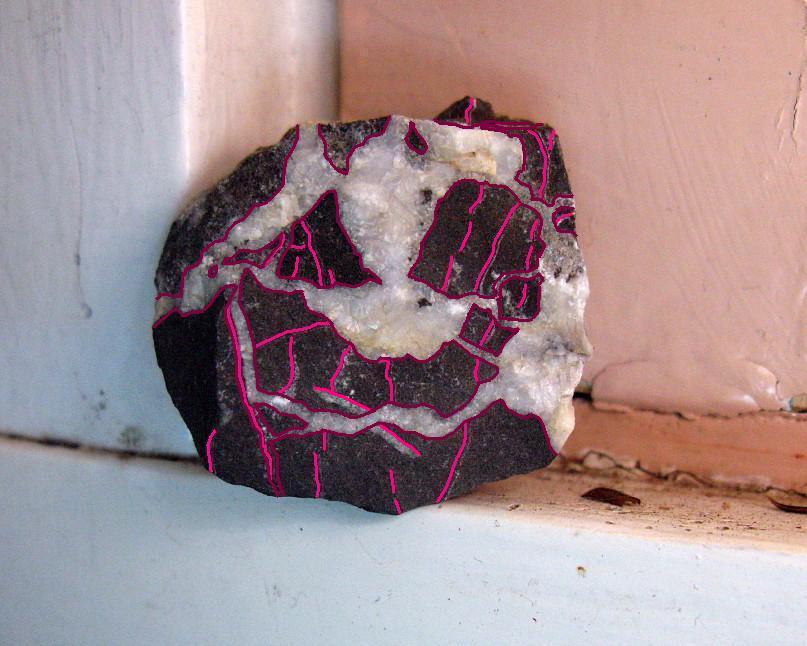
MOH brough this little gem home from a hike one day, and it was immediately in the running for top shelfcrop, seeing as how Halloween is nearly upon us and it resembles an cheerfully smiling jack-o-lantern. It has a big grin, one partly squared off round eye, and one triangular eye. In reality, it's a dark gray, brecciated dolomite (now running out to the truck to get the HCl in order to test this diagnosis - yes!). Some breccia clasts appear to have been rotated or at least moved (the triangular eye) while others appear to be nearly in place (part, or even most, of the smile); the clasts were then cemented by a matrix of white, coarsely crystalline calcite dolomite (HCl to the rescue).

This is a sedimentary rock (dolomite) that has been brecciated under unknown circumstances, given that the context (an outcrop) is missing. Consequently, I don't know what kind of breccia this is. Possibly it's a karst breccia; maybe it's a hydrothermal breccia; maybe it's a sedimentary breccia that was cemented with dolomite. Maybe it's some kind of fault or tectonic breccia. Just don't know.
Oh, and then I had to do this, thinking I saw a couple veinlet correlations...
...and then this...
...and then this. Purple outlines the breccia fragments; dark pink follows veinlets.
And here's our grinning jack-0-lantern breccia in it's current home, on a shelf, leaning against a folded towel, making it truly a shelfcrop, and a top shelfcrop, at that!

Happy Halloween!
Or, Happy Nevada Day, depending on which you prefer to celebrate. :)