In the morning after I wake up—while I'm drinking my first, second, and maybe third cup of coffee—I often think of things to write for the blog, how to write them, maybe even what pictures to use.
I also think of things to write while I'm on the way to work, bouncing around in the front seat of a pickup truck (actually, the ride is usually pretty smooth and solid, I just thought bouncing just sounded better). A moving truck is not a great place for writing (there is *some* bouncing), especially because all I have is my semi-smart phone; perhaps if I had a tablet...
My thoughts while riding or driving into work typically run along the lines of...well, maybe it's time for some drilling stories...let's see, there was the guy who yelled and threw things when he was mad at his helpers, which was almost all the time. Ugh. Or, there's a story or two floating around about drill rigs brought onto staked claims in order to make a discovery before the company that owned the claims, thereby being able to, hopefully, make claim to at least some of the already staked ground.
And then, once again, I'm back here at my computer, it's early morning, and the briefest hints of coffee are trying to course through my veins, trying to rev my brain. Ideas are at a standstill; I don't get very far...until I'm back on the road and the ideas start popping. Another story, or general story idea, will come into my head: mud and getting stuck stories. Hey, there's one just over that not-so distant hill! It happened not long ago, and, remarkably, I have a few photos for it! And not too much farther down that road and over the next hill or two to the south, there's a mud without stuckness story...and that leads to a more typical claim jumping story...which leads to another claim jumping story out of sight from this road but down a road I was writing about last fall and winter before I got distracted by our recent move.
But then, I'm sure I'm missing something...maybe it's the details...because when these ideas start while I'm on the road (any road will do, me driving or sitting as a passenger, either way), other ideas come in and crowd out and confuse the first ideas, which then sometimes include other people's stories: other accounts with drillers, other encounters with mud, other overstaking problems. Which story to tell? What details to use? And, without a tablet, and even with a small notebook, how will these stories make it from barely incipient idea to fully written account?
One story would be about the driller (and set of helpers?) that got thrown off a job down in the south-central Mojave one spring (I hope it was spring and not summer) for showing up to work drunk and carrying a small flask of whiskey or JD. The driller that came to replace him had an interesting time using one of the two only pay phones in town—and so did I, although I used the other of the two pay phones in town—but the guy that had real problems with the one pay phone, which was sitting there on the corner of Main Street and the cross street that formed the junction that made the town, was one of our claim stakers, who was out there running a soil grid across the claims he was staking. And his problems with the pay phone had something to do with the druggy nature of the town, the drugs being the second main reason for the town, the first reason being the intersection of two sub-major (major in the Mojave) roads.
And so the ideas come and go, just like that, while I'm sitting here in the morning partly coffeed up, glancing constantly at the clock so I won't be late: sometimes the ideas get written down, sometimes they don't. These kinds of stories generally don't have photos to go with them, and the Mojave stories are not likely to have photos any time soon or in any systematic fashion: collecting the photos would take almost as long as the original years of exploration.
And now, with one last chug of ever-so-good nice-and-hot coffee, I leave this post behind and start getting ready for work.
Showing posts with label coffee. Show all posts
Showing posts with label coffee. Show all posts
Tuesday, October 2, 2012


Thursday, September 15, 2011
Back from the End of the Road: AK2011 Day 8 continued
 As we were turning away from the Homer Spit, we spotted a group of cars pulled over, with people running out to take pictures of the large eagle's nest in the top of a dead tree.
 The nest held one juvenile eagle — hard to call them babies when they are nearly fully grown and probably about to fledge — and the adult in the picture (Mom? Dad?). Whereas I did get to see the juvenile, I couldn't get a photo.
 On the way back, in or just south of Ninilchik, we stopped at one of our favorite coffee places, The Buzz Café, one I've only been to once before which rapidly became a favorite because of its great coffee, convenient location, and colorful character.
 The covered sitting area makes it possible to enjoy coffee outside anytime of the year — or at least during the rainy season, not so sure about sitting outside during the snowy season.
---
An Aside: Do you remember Alaska's seasons? There is more than one way of describing or counting these, but the six seasons I'm aware of are summer, fall, freezeup, winter, breakup, and spring. Summer ends with the fall of Termination Dust, which is followed, after a fairly short fall, by freezeup (sometimes called The End) and winter. Freezeup is either a very short season or a specific event, depending on your precision. Breakup can be considered a specific event or a whole season (sometimes a season between winter and spring, sometimes one between winter and summer, the latter arrangement leaving five rather than six seasons). As a season, breakup can seem to drag on and on because of refreezes after unexpected and unwanted mid or late winter melts, followed by refreezing, remelting, refreezing — come on, let's get it over with! Breakup is often considered the season of mud, and people wear special breakup boots. (Read more about breakup boots here and here.)

Breakup the event is marked by the "breakup" of ice in local rivers. In central Alaska, breakup may be defined at least semi-officially as the date, hour, and minute when the Tanana River ice breaks and starts to move downstream. Betting on the timing of this event takes place as part of the Nenana Ice Classic (Tanana, accent on the 1st syllable, is the river; Nenana, accent on the 2nd syllable, is the town.) Tanana River breakup dates through 2010 can be seen on the Ice Classic webpage; also see this NSIDC graph of breakup dates, which unfortunately only goes to about 2000.
---
 With our coffees still hot, we stopped briefly at the Russian Orthodox church on the bluff above Ninilchik Village, and I walked over to get this view of a muddy town and a cloudy Cook Inlet.
 And so ended our trip back from the end of the road, although we still had time and distance to go, and we probably made at least one stop prior to returning to our favorite spot on the river.
(There is more, although my blogging attention span is being stretched here.)
Sunday, March 6, 2011
Light and Color on a Cozy Indoor Day
 It's cloudy and threatening snow outside, and I'm staying indoors, pretending we have a warm stove radiating heat, drinking coffee mixed with cocoa. This one corner of our little house usually looks fairly uncluttered, and sometimes the plants even get a bit of light. Not today. The upper shelves are stacked with various books, mostly geology or travel related, though not entirely. Titles I can read from here include A Garden of Bristlecones, Blue Highways, Alaska: Saga of a Bold Land, Topo! for Nevada, and Nevada Off the Beaten Path. I recommend all these books, though I can't comment about the Topo! program, as I haven't used it.
 I'd say that it's probably cabin fever that's keeping me indoors, but that's not right: surely cabin fever would send me outside despite the dreary weather. It must be something else.
 Over near the front door, a door used only to retrieve mail, the plants look bright and cheery, even as if the sun were shining through the clouds, but their color has as much to do with the camera setting as anything else.
 Um, maybe it's time for more coffee.
Wednesday, January 26, 2011
How to Make Coffee Strandlines or Rhythmites
 Once upon a time, MOH and I left suddenly for an unexpected trip of unknown time duration, and I failed to empty all the coffee cups. Upon arriving back, having been gone most of 14 days, I tentatively looked in my cup expecting to find terrible mold, instead finding these lines of coffee deposited around the side of the cup.
"Varves!" I exclaimed, "Except they aren't from yearly deposits, they're from daily deposits!"
I've reflected a little, and asked a few close-at-hand sources, and decided these aren't really varves — and they probably aren't really rhythmites, either — for the simple reason that varves and rhythmites would be layers, of concentrated coffee in this case, that would have been deposited in the bottom of the cup. Instead, these must be more akin to strandlines — or shorelines around a coffee lake, in this case — as suggested by @GeoTheoBO. Other suggestions for what to call these deposits were Stratified Caffineite (@CGKings317), rhythmites (@alexbirtwisle), and my favorite, "Jarves" from "Java-varves" (@Dhunterauthor). Everyone else is welcome to jump into this discussion and naming exercise in the comments.
 Prior to deciding that these were really the results of daily evaporation of coffee, I did count the rings. There are 13, with a possible incipient 14th one near the bottom representing the partial 14th day during which we arrived back in time to check the cup. The lines I've drawn above are based not just on the locally fuzzy record shown in that one photo, but on the three photos I took documenting the entire stratigraphic record around the entire inner part of the cup.
 Here are the final determinations. A few of the days are a little fuzzy and the lines have been brought in from the side, just like you might have to do when correlating deposits out in the field. Most day's deposits are light toward the bottom and darken upward, possibly reflecting something having to do with diurnal temperature and humidity variations. To be honest, I don't really know when the darkest portion of each day's ring forms, whether at night, during the day, or at some other time. The cup was sitting on the kitchen counter in the sunlight of the window the entire time we were gone; evaporation would presumably have been strongest during the daylight hours, possibly resulting in the lower, lighter colored part of the layer. Any other thoughts?
This post has been submitted to the Bake-Sale Accretionary Wedge (AW#30), though no baking was involved.
UPDATE: Accretionary Wedge #30: the Bake Sale is now up at Mountain Beltway. It's a very yummy Wedge, I might add.
Thursday, November 12, 2009
Inside the Interzone
On the fourth day of my journey to the GSA meeting, I made my way to Portland from Eugene via some non-interstate roads that took me through Corvalis, home of The Interzone, Lockwood's favorite coffee shop.
 I went inside and met that coffee shop denizen, the geological, political, satirical blogger at Outside the Interzone.
 It's a colorful place, bustling with activity. Students and others come and go, and people hang around writing, studying, blogging, and what have you.
Bicycles are everywhere outside, which is a good thing, because if you don't happen to have a university parking sticker, you are unlikely to find a nearby parking space that lasts longer than an hour (or was it two?). I didn't want to feed the meter, because the meter maid was out in full force, looking forpeople with California plates anyone overstaying their welcome. I parked in three different parking places, the last one being several blocks away.
But don't let that stop you from dropping in: the coffee is good, the company is excellent!
 Lockwood was a great host. He immediately bought me an Americano with room for cream, then we both sat at his table with our respective laptops plugged in and open, looked at routes to Portland on Google Maps, chatted, got over-coffeed (I did, anyway), read some blogs, and chatted. As I was leaving, Lockwood gave me a specimen of natrolite in calcite, which I was duly instructed to give to Callan Bentley of NOVA Geoblog when I got to the geoblogger meetup in Portland Monday night (photo here). Mission accomplished!
 Yes, I really was there, on the inside, looking outside at the Interzone sign.
 I went inside and met that coffee shop denizen, the geological, political, satirical blogger at Outside the Interzone.
 It's a colorful place, bustling with activity. Students and others come and go, and people hang around writing, studying, blogging, and what have you.
 Bicycles are everywhere outside, which is a good thing, because if you don't happen to have a university parking sticker, you are unlikely to find a nearby parking space that lasts longer than an hour (or was it two?). I didn't want to feed the meter, because the meter maid was out in full force, looking for
But don't let that stop you from dropping in: the coffee is good, the company is excellent!
 Lockwood was a great host. He immediately bought me an Americano with room for cream, then we both sat at his table with our respective laptops plugged in and open, looked at routes to Portland on Google Maps, chatted, got over-coffeed (I did, anyway), read some blogs, and chatted. As I was leaving, Lockwood gave me a specimen of natrolite in calcite, which I was duly instructed to give to Callan Bentley of NOVA Geoblog when I got to the geoblogger meetup in Portland Monday night (photo here). Mission accomplished!
 Yes, I really was there, on the inside, looking outside at the Interzone sign.
Saturday, June 6, 2009
A Walk: Across Town and Back
It was sunny, yesterday, for the first time in several days, and cooler than is normal for early June. Rather than hiking up the hill, I walked around town, thinking that I'd do a few minor shopping errands. Instead, I meandered around and looked at things.
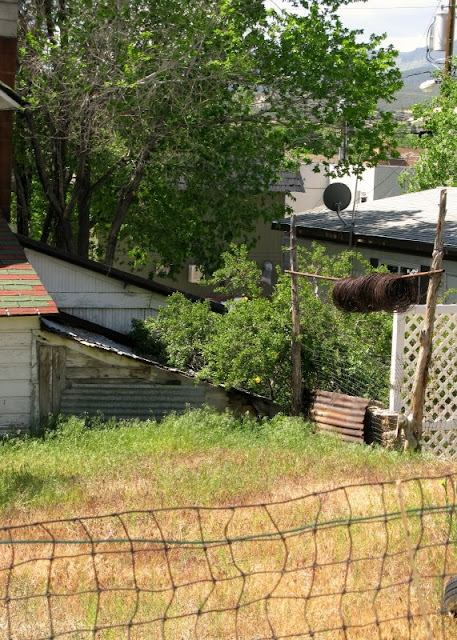 The backyard of a nearby old house - the one we sometimes call "our house" though we don't live there and probably never will - is a bit overgrown with lots of cheat grass. Two yellow roses bloom on the bush overhanging the shed roof. (Look closely, or enlarge!)


 The wind was strong enough to almost knock me over at times, and blustery clouds came up before I had gone more than two blocks.
 Semi-wild yellow climbing roses adorn the stairs of an old house.
 Red climbing roses - an old variety brought west by settlers or miners - are often found growing wild or semi-wild in western towns.

 As I meandered around, I more or less followed the old railroad tracks, which lead to the Nevada Northern Railway depot. I don't really know what the tall, cylindrical, concrete thing above is, but it's close to the railroad and looks a lot like a smokestack. I found nothing about it or it's history online, other than one unlabeled photo. (The wide angle setting on the camera distorted the 90° angle where the lower, bridge-like structure meets the tall cylinder.)

 Having made it that far, I moseyed over to the only stand-alone espresso shop in town. I had a mocha frappuccino, then a brisk walk back across town into the wind.
 The backyard of a nearby old house - the one we sometimes call "our house" though we don't live there and probably never will - is a bit overgrown with lots of cheat grass. Two yellow roses bloom on the bush overhanging the shed roof. (Look closely, or enlarge!)
Pink.

Paint.
 The wind was strong enough to almost knock me over at times, and blustery clouds came up before I had gone more than two blocks.
 Semi-wild yellow climbing roses adorn the stairs of an old house.
 Red climbing roses - an old variety brought west by settlers or miners - are often found growing wild or semi-wild in western towns.
Sign: If You Can Read This, You're In Range. (Watch out, it's Nevada!)
 As I meandered around, I more or less followed the old railroad tracks, which lead to the Nevada Northern Railway depot. I don't really know what the tall, cylindrical, concrete thing above is, but it's close to the railroad and looks a lot like a smokestack. I found nothing about it or it's history online, other than one unlabeled photo. (The wide angle setting on the camera distorted the 90° angle where the lower, bridge-like structure meets the tall cylinder.)
A railroad car in front of the "Safety First" building.
 Having made it that far, I moseyed over to the only stand-alone espresso shop in town. I had a mocha frappuccino, then a brisk walk back across town into the wind.
Monday, January 26, 2009
Morning Snow
...in photos.


 The way it looked while I was out shoveling snow early yesterday morning. I got up at 3:00 am, partly because I couldn't sleep, and went out and shoveled snow for almost an hour before having coffee. That way, I made sure the Prius could get out of the driveway, while MOH slept in just a tad.
It wasn't all that cold, probably right around freezing, and the snow was wet and heavy. Everything I wore got wet from sweating. I went in, changed into dry clothes, and after having coffee and breakfast went back out at about 6:5o am, just around sunrise, and took the snow photos. My hands froze.
Tuesday, November 18, 2008
Five Things Meme
I'm taking this one from Cath @ VWXYNot?, who tagged "anyone whose breakfast included / will inlcude cheese." [The breakfast was scrambled eggs with cheese.]
5 things I was doing 10 years ago:
(Let's see, 10 years ago was 1998.)

5 things on my to-do list today:
(Checks calendar - oh, today's a day off.)
5 snacks I love:
5 things I would do if I was a millionaire:
5 places I've lived:
5 jobs I've had
5 rocks I love:
(For geologists or any others who also want to add rocks.)
5 categories of people I'll tag:
5 things I was doing 10 years ago:
(Let's see, 10 years ago was 1998.)

- Watching one of my nieces take her first steps.
- Packing an over-full U-Haul.
- Driving down the Alcan.
- Finding a new place to rent.
- Looking for work.
5 things on my to-do list today:
(Checks calendar - oh, today's a day off.)
- Sleep late. ✓
- Have coffee.✓
- Mail bills.✓
- Do some laundry.
- Go for a hike.✓
5 snacks I love:
- Ice cream, almost any ice cream.
- Coffee with cocoa / coffee without cocoa / cocoa without coffee
- A Blizzard (especially when in Alaska).
- Peppermint patties.
- Reesie cups (okay, so I spelled it wrong).
5 things I would do if I was a millionaire:
- Drive the Alcan again, taking my time for once.
- Buy a new field vehicle, one that gets good mileage.
- Build a new house in the back yard.
- Use solar panels.
- Work less; donate more.
5 places I've lived:
5 jobs I've had
- Receptionist [yuck].
- Teach Op Min and Petrology.
- Geologist.
- Artist.
- Consultant.
5 rocks I love:
(For geologists or any others who also want to add rocks.)
- Breccia, any kind.
- Ash-flow tuff (did I mention breccia?)
- Veins (and brecciated veins)
- Rocks with secondary K-spar veinlets (I don't like these to be brecciated, but the veinlets can cut breccias).
- Jasperoid (also to hate, if sampling), brecciated or not.
5 categories of people I'll tag:
- Any geologist.
- Anyone who has driven the Alcan, in either direction.
- Anyone who has lived north of the Arctic Circle.
- Anyone who hates moving.
- Anyone who considers themselves an artist.
Wednesday, October 8, 2008
Finally Some Fish: AK2008 Day 3
 As I noted in an earlier post about this Alaskan saga, it was hard to get photos showing the height of the rollers, as they called the waves out there in Cook Inlet. The photo above, of a relatively nearby fishing boat, is what we probably looked like as we rolled up and down, and as we got about the business of fishing.
BTW, I don't know if halibut fishing qualifies as an actual Alaskan Experience, in capital letters. I'd have to ask an Alaskan about that. I know that any bear encounter in Alaska qualifies. Fortunately, I haven't had any of those, except when inside a vehicle (and while Outside Alaska on the Alcan). And those were black bears, anyway, not giant grizzlies (a nice black bear picture here at Geotripper). In Alaska, I've only had encounters with grizzly tracks and grizzly scat.
 Back to fishing. First, you get down these huge fishing poles - or, rather, the deckhand working up there for the summer gets down the huge fishing poles - and then you jam them into some pole-holder-thingies on the sides of the boat. You don't hold the poles. The poles and fish are too large for that, and if you got a fish on while holding a pole, you'd soon lose both pole and fish. (At least that's how we did it - I can't tell for sure about the guys in the blue boat above.)
 Before putting the poles in place, the deckhand has gotten them all rigged up with the appropriate gear. He puts a smallish fish on each line for bait, then you reel it down until the bait is sitting on the bottom, however far down that happens to be. I, personally, couldn't tell when the bait reached the bottom.
After awhile, in fact immediately, you will get a halibut on the line. The captain or deckhand says, "You've got one on!" Then you are supposed to let it eat and swallow the bait completely, without letting it take too long. You are not supposed to reel too soon to set the hook, as in regular river-type fishing; the halibut is supposed to set the hook itself. If you reel in too soon, you won't have a fish. If it nibbles awhile and you reel in too late, you won't have a fish. I totally could not get the hang of this! So by the time they would say to reel in, it would be too late. Or, thinking that I had it figured out, finally, I'd go ahead and reel in, then the captain (especially, the deckhand was more patient or pragmatical) would act all exasperated and go help someone else. Eventually, though, with the help of the deckhand, I finally pulled in two halibut. But give me silver salmon, any day!
We all caught our limit of two. That was eight 20-30 pound halibut for our group of four (MOH, my parents, and myself). We spent from about 10:30 am AKDT to about 12:10 pm AKDT catching our fish. So, that's get there: 1.5 hours; fishing: 1.5 hours; and then, head back.
 As you are catching the fish, the deckhand is putting them in a large metal box in the center of the back deck.
 When fishing is all wrapped up and when things are all put away, the deckhand spends some time throwing water around to clean things up, including putting a bunch of water all over the halibut, to keep them cold.
 Here, above, we have turned around in order to pull up the anchor, so we can hightail it back to shore.
 Ah, shore. Does it look familiar? Well, it looked quite familiar to us, lighthouse and everything. With all the rollers pushing us from behind, it took us a lot less time to get back, from about 12:10 pm AKDT to 1:00 pm AKDT: about 1.5 hours going out v. less than 1 hour coming back in.
 Seagulls, boats, and boatmen await our arrival on the beach at Deep Creek.
 Land! I'm standing on it! No more rolling around!
 As we come in, another one goes out.
 Here are a couple views of the fish we caught. Big halibut strung up on this post would touch the ground. We caught a bunch of "chickens" - small, but good-eating halibut.
 A second look at the white side of our halibut with captain for scale.
 Our three largest fish, maybe 30-pounders or so.
 And then we're done! So we drive north on the Seward Highway toward Kenai, stopping at the first coffee place, called Electric Beach Tanning & Espresso.
 Then, after a long afternoon of cutting and processing fish, we have some beer in the evening, one of my favorites: Alaskan IPA.
Subscribe to:
Posts (Atom)