Showing posts with label family. Show all posts

Wednesday, January 15, 2014

Road Song: The Highwayman

The Highwaymen: Highwayman (lyrics)
Album: Highwayman, 1985

This song--like this one posted earlier--reminds me of "the road" and of life on the road as an exploration and recon geologist. It also reminds me of my Dad: because one of his favorite artists, Willie Nelson, is one of the singers; because of the dam building and Boulder Dam reference (even though the building of that dam was before his time); and because he'll always be around (at least for me).

Here's a second version (essentially the studio version, although the accompanying video references to "starship" don't match my Star Trek ideas of what starships really are and will be).

Tuesday, December 10, 2013

Road Song: On the Road Again

Willie Nelson: On the Road Again
Album: Honeysuckle Rose, 1980

This is an obvious Road Song, one for which, possibly, the category was named. In fact, the song was *on* one of the first road song tapes — surprise, surprise! Another of the first road song tapes can be played or perused  here.

On the Road Again is from the early 80s (barely 80s), when we were all on the road. It reminds me of roads, Highway 50, central Nevada, geologists, driving late at night to get home, driving anywhere to get out into the field, geological heroes, and much, much more. Today, it's dedicated to my Dad. My mom, a child of the 30s and 40s, was inspired to play this song (among many others) at his memorial service. The associated, perhaps fortuitous, metaphor, just stuns me.

Thursday, January 20, 2011

Three Years Ago Today: Old Burner

Three years ago today, while driving the backroads north of Truckee, CA, I came across this old wigwam burner located in the small town of Sattley (Google Street View). These burners were used to burn sawmill and logging yard wastes until they were decommissioned during the 1970s to early 1980s — at the latest — due to both economic and environmental concerns (including the Clean Air Act of 1970).

I remember seeing a lot of these burners while traveling in Oregon and California (especially Oregon) during my younger years, and so I associate them with my childhood. For some unknown reason, I have also come to associate the burners with the sickly smell of paper mills, even though sawmills and paper mills didn't (usually?) occur in the same locations.

The stench of a paper mill — a strangely fond olfactory memory of sorts, because paper mills remind me of my grandparents' old house — is nearly indescribable: it is strong and penetrating, sharp to the nose, sometimes intolerably so if the wind is in the wrong direction or if the air is just hanging and not moving. I've heard some say that the thick smoke smells like rotten egg, a typical sulfur smell, which would make sense because one of the key ingredients of the output of paper mills is hydrogen sulfide, one of several TRS compounds (TRS = total reduced sulfur). In my memory, the smell is something stronger or sharper or sicklier than that of rotten eggs, and some have mentioned rotten cabbage or rotten broccoli (eew!).

This compilation shows that zero sawmills are located in Oregon at present.

A Few Relevant Links:
Wigwam Burners / TeePee Burners on Flickr
List of remaining burners in the U.S.
Odors from Paper Mills
Pulp and Paper Industry Odors
Total Reduced Sulfides

Total Reduced Sulphur Compounds
That reeking paper mill keeps Franklin running

Saturday, September 19, 2009

Road Song: May the Road Rise


Roger McGuinn: May the Road Rise
Album: Live from Mars, 1996

As sung in 2007.

This road song is a new one for me, one based on an old Irish blessing - see this lyrics link for the blessing, and for all the lyrics - one verse is left out on this video version.

This song is dedicated to R & R, who have both been in our thoughts much recently.

Thursday, August 13, 2009

Where in the West: Broken Top and Sisters Area, July 2006

The Sisters area was covered by smoke from the Black Crater Fire,* which started not long before I drove into Oregon for a family reunion in late July, 2006. Consequently, the view looked like this when my parents and I drove west toward Sisters on Highway 126 (MSRMaps map).
We didn't know how close we could get, and we finally came to this field on the McKenzie Pass Highway just west of Sisters, barely out of town, which is one of the best viewing areas to see the Three Sisters.
The Three Sisters were mostly hidden by the smoke, but Broken Top - the subject of this month's Where in the West - was, for the most part, visible beneath the thick, dark, smokey blanket. Lots of fire-fighting planes were flying in and out of the area...
...so we took a lot of photos of them flying around, including the two above with Broken Top, or part of it, in the background.
The next day - although the fire hadn't been put out and Sisters was under threat of evacuation (and was eventually partially evacuated) - the view of Broken Top (MSRMaps map) from the Cascade Lakes Highway** was amazingly clear, despite the haze and smoke almost everywhere else, including at our reunion site north of Redmond.
The Cascade Lakes Highway has some great views of the volcanic landforms of the region; the road goes just north of Mt. Bachelor, seen above looking up into a cinder cone on its north side.
We made it to this turnoff (I think to Mt. Bachelor ski area), where the road to the left was signed no-entry because of a fire camp. This is a great area to stop and see the South Sister, and the Dutchman Flat viewing area for Broken Top is either shortly before or shortly after this road junction.
Later, if you are of a mind to and still happen to be in the area, you can have dinner in Tumalo.
If you are a photophile, you can play with the settings on your camera and take weirdly colored sunset pictures.
And if you are supremely lucky, you can marvel at the apt sentiments found on a typical geologist's T-shirt.

* The Black Crater Fire continued into August, long after we had left the area, and resulted in some evacuations. For those who are interested, more pictures of the fire can be seen here and here, and more information can be found on the web.

** The Cascade Lakes Highway leaves southwest Bend as SW Century Drive or Century Drive Highway according to Google Earth and the Oregon Atlas & Gazeteer.

Monday, June 22, 2009

Two Years Ago Today: Wrens Nesting

Two years ago today, I had just arrived at our lake home after my first full month of working in eastern Nevada. It was spring, and a pair of wrens were nesting in a bird house in our backyard.
First, they would get close and carefully eye the nest and everything around, while hiding in nearby bushes or trees. This wren has a small grub or something in its beak.
They built an unusual-looking nest, one with twigs sticking out of the hole. The twigs tightened up the entryway, protecting the nestlings from anything larger than a wren.

Part of the action is not just to bring food in for the baby birds, but to take out the trash. Somewhat neater than messy diapers, I think.
Both the male and female wren were involved in the feeding and trash-taking-out operations, dividing their chores evenly as far as I could tell.
While watching the wrens, I caught this patient birder taking pictures of them.

Saturday, December 27, 2008

RoadTrip Update: Holidays below the Flatirons

Posting and commenting has nearly fallen by the wayside while I sit and bask in the sun and clouds and wind of the Rocky Mountain Front Range. So far, I still haven't climbed up to the base of the giant Flatiron outcrops, not only because the visiting schedule here has been intense, or at least full, but also because I have caught one of those nasty holiday viruses. This one may have come all the way from Alaska, or maybe it came from Nevada, Utah, or Colorado! Hopefully it will be in retreat by the time I need to head back home.
I've had some nice relaxing times sitting by the tree and gazing out the window...
...and have also gotten out and about a bit. The tree above was in the two-story lobby of the Hotel Boulderado, a fancy old European-style hotel and a great place to eat.

Hope you all are having good holidays!

Tuesday, December 23, 2008

RoadTrip Update: The Front Range

flatirons As you can see by comparing the photo taken a couple days ago, above, to the one taken in early summer a couple years ago from a slightly different angle, here, The Flatirons look about the same. There is the addition of a bit of snow, which can be seen mostly in the foreground, and the subtraction of a few clouds. I suspect some snow is hiding under trees, in gullies, and behind rocks in the background. Quite frankly, I expected a lot more snow.

So far I haven't had the chance to walk up to the rocky outcrops, but have instead been resting, visiting, and getting ready for last-minute shopping.
new snow Here in the suburbs, we had less than a skiff of new snow last night, which fell on patchy old snow and ice.

Thursday, December 18, 2008

Holiday Trip

sign I will be traveling into this part of the world soon...
cliffsPassing through here, right by the Book Cliffs on I-70...
flatirons On my way to here, in the Denver area, although I don't expect The Flatirons on the Front Range to look like this: they should be all snow-covered! I'll be stopping to meet a couple geo/bloggers on the way.

I don't know how my posting will go; I don't even know what the internet access will be like. I'll have comment moderation on by Friday, at least for awhile (if it isn't on sooner due to recent comment-spam attacks).

I will head back west after visiting family near the end of the month, probably just before the New Year, but am not sure of the timing quite yet! If any other geo/bloggers in the region are interested in meeting for coffee or lunch or something, please contact me by email.

Monday, October 20, 2008

Bank Fishing: AK2008 Days 4-8

Fishing and Alaska, continued.
pixieMy favorite lure for catching silver salmon in the Kenai River - a bright orange pixee. Bright green is also good.
sand area My favorite bank-fishing area.
gravel area 1 The bank from which we actually fished.
gravel area 2Another view of the bank we fished from, taken from a boat in the river.
fisher My favorite fisherwoman - actually, our best fish catcher; she usually catches fish even when no one else does.
boots Yours truly after catching more than enough pink salmon: I needed to take a break. We don't generally keep pink salmon. As soon as they leave salt water for the river, they start "turning" - as do all salmon - but fast, with the males getting a large hump on their backs. So they are also called humpies. They are smaller than silver salmon, are kind of bony, and are often mushy, especially the males. Sometimes a good, silver-looking female pink is okay to keep and eat. Sometimes they are good for smoking. I read recently that they are underrated, but quite frankly, I don't think so! Pink salmon is fine as commercial fish caught out in salt water and sold in cans; it is merely okay to much less than okay if eaten out of a river.
bucket The famous empty bucket, waiting for a silver salmon. Fishing for silver salmon on the Kenai River in even-numbered years is challenging, because the pinks (humpies) run every other year - odd-numbered years are preferred, because the pinks aren't running. Fishing in even-numbered years goes like this: cast, hook or snag a humpie, drag it in, unhook it, throw it back in. Cast again. Cast again, drag in another humpie. And so on. You will probably catch a humpie on about every other cast.

Catching a humpie is like snagging your line on the bottom of the river - so much so, that sometimes you really can't tell whether you are snagged on the bottom or have managed to catch a humpie. It's especially similar if you happen to be standing in a boat. Silver salmon, on the other hand, are exciting to catch, and will usually jump out of the water, trying to throw the hook, and will run with your line, and jump again, and jump again. You are lucky when you catch one. Make sure the hook is well set!

It's fun to be catching something, but I've done this pink-humpie thing enough times in years past, to get tired of catching humpies pretty fast after the first or second day.
lure Finally, after a couple days, we decided to change lures to a Vibrax No. 4 or No. 5. [Be sure to check fishing regulations each year before using any particular lure. Some are too big, or are otherwise illegal, and regulations change.]
pink And what's that? Another humpie? Aaargghhh...
cast A great cast by our most persistent fisherman, and hence, our top catcher of silver salmon!
grass When fishing, remember to go out when it's early, mid-day, late, later, foggy, cloudy, sunny, rainy - in fact anytime that you aren't doing something else.
rocks If you get bored, at least there are rocks to look at!

A Geology Reference:
Richard D. Reger, R.D., and Petrik, W.A., 1993, SURFICIAL GEOLOGY AND LATE PLEISTOCENE HISTORY OF THE ANCHOR POINT AREA, ALASKA: Alaska Division of Geological & Geophysical Surveys, PUBLIC-DATA FILE 93-50b, 8 pp.

Wednesday, October 8, 2008

Finally Some Fish: AK2008 Day 3

other boat As I noted in an earlier post about this Alaskan saga, it was hard to get photos showing the height of the rollers, as they called the waves out there in Cook Inlet. The photo above, of a relatively nearby fishing boat, is what we probably looked like as we rolled up and down, and as we got about the business of fishing.

BTW, I don't know if halibut fishing qualifies as an actual Alaskan Experience, in capital letters. I'd have to ask an Alaskan about that. I know that any bear encounter in Alaska qualifies. Fortunately, I haven't had any of those, except when inside a vehicle (and while Outside Alaska on the Alcan). And those were black bears, anyway, not giant grizzlies (a nice black bear picture here at Geotripper). In Alaska, I've only had encounters with grizzly tracks and grizzly scat.
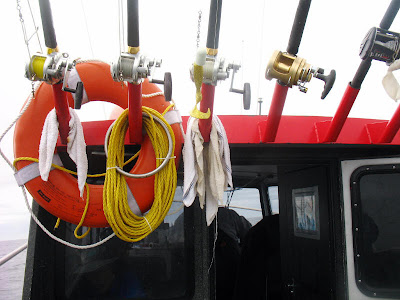
poles Back to fishing. First, you get down these huge fishing poles - or, rather, the deckhand working up there for the summer gets down the huge fishing poles - and then you jam them into some pole-holder-thingies on the sides of the boat. You don't hold the poles. The poles and fish are too large for that, and if you got a fish on while holding a pole, you'd soon lose both pole and fish. (At least that's how we did it - I can't tell for sure about the guys in the blue boat above.)
fishing stuff Before putting the poles in place, the deckhand has gotten them all rigged up with the appropriate gear. He puts a smallish fish on each line for bait, then you reel it down until the bait is sitting on the bottom, however far down that happens to be. I, personally, couldn't tell when the bait reached the bottom.

After awhile, in fact immediately, you will get a halibut on the line. The captain or deckhand says, "You've got one on!" Then you are supposed to let it eat and swallow the bait completely, without letting it take too long. You are not supposed to reel too soon to set the hook, as in regular river-type fishing; the halibut is supposed to set the hook itself. If you reel in too soon, you won't have a fish. If it nibbles awhile and you reel in too late, you won't have a fish. I totally could not get the hang of this! So by the time they would say to reel in, it would be too late. Or, thinking that I had it figured out, finally, I'd go ahead and reel in, then the captain (especially, the deckhand was more patient or pragmatical) would act all exasperated and go help someone else. Eventually, though, with the help of the deckhand, I finally pulled in two halibut. But give me silver salmon, any day!

We all caught our limit of two. That was eight 20-30 pound halibut for our group of four (MOH, my parents, and myself). We spent from about 10:30 am AKDT to about 12:10 pm AKDT catching our fish. So, that's get there: 1.5 hours; fishing: 1.5 hours; and then, head back.
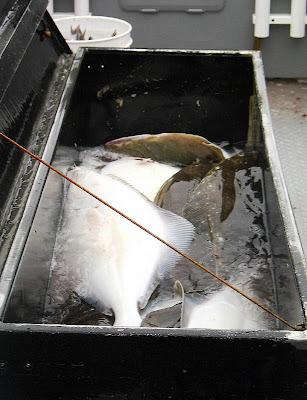
fish in box As you are catching the fish, the deckhand is putting them in a large metal box in the center of the back deck.
water on fish When fishing is all wrapped up and when things are all put away, the deckhand spends some time throwing water around to clean things up, including putting a bunch of water all over the halibut, to keep them cold.
Here, above, we have turned around in order to pull up the anchor, so we can hightail it back to shore.
Ah, shore. Does it look familiar? Well, it looked quite familiar to us, lighthouse and everything. With all the rollers pushing us from behind, it took us a lot less time to get back, from about 12:10 pm AKDT to 1:00 pm AKDT: about 1.5 hours going out v. less than 1 hour coming back in.
Seagulls, boats, and boatmen await our arrival on the beach at Deep Creek.
Land! I'm standing on it! No more rolling around!
As we come in, another one goes out.
Here are a couple views of the fish we caught. Big halibut strung up on this post would touch the ground. We caught a bunch of "chickens" - small, but good-eating halibut.
A second look at the white side of our halibut with captain for scale.
Our three largest fish, maybe 30-pounders or so.
And then we're done! So we drive north on the Seward Highway toward Kenai, stopping at the first coffee place, called Electric Beach Tanning & Espresso.
Then, after a long afternoon of cutting and processing fish, we have some beer in the evening, one of my favorites: Alaskan IPA.