Having been provoked by a recent online coversation, I've decided to take a quick moment to post a (late) addition to this month's Accretionary Wedge topic, a geological pilgrimage to "a single place, which is 'geologically' unique, relatively remote, and requires some difficulty to get to.'" I had thought I wouldn't post anything, because I'm not sure of making it anywhere besides, possibly, Midas, Tuscarora, and the Galápagos Islands, all of which I've put off for years, but which are all still on my list. But, taking a page from Ron Schott, I'll post briefly about a place I'd really like to see, though I have no particular plans or prospects of getting there: the South China Karst, also here and here. I don't really know why I find the area fascinating, but here is one video showing some of the lure, with some alluring music:
Showing posts with label china. Show all posts
Showing posts with label china. Show all posts
Thursday, May 3, 2012


Saturday, November 14, 2009
Late Night Ramblings: From Becke Lines to Mining Scams
Poetic. It's not that I'm feeling poetic, but that word came to mind, so I wrote it down.
I've had the jimmy legs while trying to sleep, so I've opened the window a crack and am drinking a cold dPf while writing in my journal. I'm using a headlamp with a red LED - this has the odd effect of giving the shadow of my moving pen a deep turquoise line on the left side (toward the light) and a deep red line on the right side (away from the light and more or less behind my hand). These colors, and their arrangement around the edges of my pen and hand, remind me first of Becke lines, which surround mineral grains immersed in oils or epoxy media. Then - especially when I turn the pages of this spiral journal - they remind me of 3-D glasses, as if I've somehow entered some supra-dimensional movie. I haven't, though, I'm just writing and wondering where the one-day-late snow is, and whether I have the window cracked too far open for comfort.
(The deep turquoise and deep red lines - which may entirely be optical effects inside my eyes, as I can only see them when the pen shadow or journal moves - has the effect of making this red-lit white paper appear pink to orange to occasionally yellow. It's as though my eyes are trying to convince my brain that I'm using ordinary incandescent lighting.)
And that reminds me - didn't some country just recently outlaw incandescent bulbs? (Actually, several have.) If only the other bulbs worked consistently. I try to buy the most expensive ones in hopes that they will turn out to be the best ones. Hopefully there is enough "byproduct"mercury from the gold mines of the world so we won't have to go back to mining mercury at mercury mines - such as the ones in Spain and Slovenia (Almadén, Idrija) and the ones in the Coast Ranges of California (New Almadén, New Idria). Seeing liquid mercury drip from old trench and pit exposures is something I'd rather not see every day. And, likewise, running across old-looking but still-in-use jars of mercury used for gold extraction by old-timers - whether in some out-of-the-way prospect north of Napa Valley or down some dusty dirt road in the Mojave Desert - is not something I like to come upon unawares or unexpectedly.
The old-timers in question (some of them are still around, perhaps?) are always quite casual about showing you their gold-rich mercury, and they are equally casual about showing you their dusty, disorganized assay labs out in the middle of nowhere. Jars, bottles, and tools of all sorts are scattered on old wooden work benches built against walls - these are their lab tables. From one etched, north-facing window, you have a nice view of the creosote desert and rocky granitic mountains. Want to have lunch in here? (I think not.) And is that an ice chest I see over near the doorway to the main cabin? Yes, the garage-shed assay-lab is attached to the living area of this old field shack. Too many rusted and broken parts, too much dust, and too many old and unknown lab chemicals are lying around loose.
Where did you say you're getting the gold from? Those pinkish brown, fractured granites over there, the ones with the narrow seams of goethitic iron-oxides in either brown carbonate or microcrystalline silica? Veins, you call them? I think I'd be being generous if I called them veinlets. Okay, we'll high-grade just those tiny veinlets, and then we'll see. We'll get back to you after our commercial lab does its thing. (No, you can't do the assays for us. We're already thinking that you got the gold the same place you bought the mercury - maybe in some old Mother Lode mining town?) Maybe we'll be back, and maybe we won't - but no, we won't be looking at your lab anymore, no matter how proud you are of it.
Not to be disparaging about your claims, but though the ankeritic-goethitic veinlets are interesting, they look too narrow and mostly too far apart to be likely to carry the barren granite they're cutting. (Although it's true, they could indicate something at depth, or something underneath that shallow alluvium just over there, right off your claims. But don't worry, we'll still want to lease your claims - if there is anything we want to come back to after we see some real assay numbers.)
(Besides which, old Joe up the road apiece - quite apiece at that - warned us that you were running some kind of scam down here. But maybe he just wants us to lease his claims, not yours. So, we'll see.)
And who was I with, down there in the east-central Mojave? Seems it was in the same area where a small gold mine was operating - the mine that routinely over-loaded their blast holes such that the metal roof of their mine office had dents and holes from large rocks that fell out of the sky every day, rocks blasted out of their small open pit. We ate lunch near the buses, that field trip day, then drove an entire mile away to avoid the coming bombardment.
I don't know what year it was. The location suggests to me that I was there with either PB or NJ - although the sampling part could have been a joint effort with BS and an assistant of his - except I don't think we worked that area with double partners. So the answer may be forever lost in the dirt and dust of that messy lab or in the steep and rocky slopes two canyons over.
Could I find that mine shack again? Maybe. I have a geographic location tucked firmly away in my head - it's a little SSW of that small gold mine, down some wide southerly-heading dirt road, generally SE of that broad, alluvial-choked peak, and in some vague area between or amongst two north-south-trending ranges. Besides which, unless it was on a tiny piece of private land, it's probably gone.
From 12Nov09, 9:33pm
I've had the jimmy legs while trying to sleep, so I've opened the window a crack and am drinking a cold dPf while writing in my journal. I'm using a headlamp with a red LED - this has the odd effect of giving the shadow of my moving pen a deep turquoise line on the left side (toward the light) and a deep red line on the right side (away from the light and more or less behind my hand). These colors, and their arrangement around the edges of my pen and hand, remind me first of Becke lines, which surround mineral grains immersed in oils or epoxy media. Then - especially when I turn the pages of this spiral journal - they remind me of 3-D glasses, as if I've somehow entered some supra-dimensional movie. I haven't, though, I'm just writing and wondering where the one-day-late snow is, and whether I have the window cracked too far open for comfort.
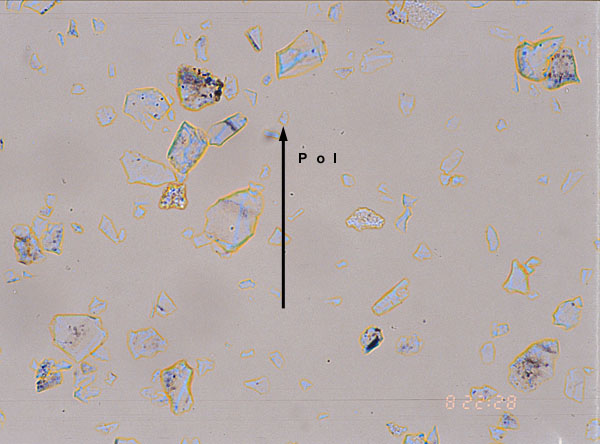
(The deep turquoise and deep red lines - which may entirely be optical effects inside my eyes, as I can only see them when the pen shadow or journal moves - has the effect of making this red-lit white paper appear pink to orange to occasionally yellow. It's as though my eyes are trying to convince my brain that I'm using ordinary incandescent lighting.)
And that reminds me - didn't some country just recently outlaw incandescent bulbs? (Actually, several have.) If only the other bulbs worked consistently. I try to buy the most expensive ones in hopes that they will turn out to be the best ones. Hopefully there is enough "byproduct"mercury from the gold mines of the world so we won't have to go back to mining mercury at mercury mines - such as the ones in Spain and Slovenia (Almadén, Idrija) and the ones in the Coast Ranges of California (New Almadén, New Idria). Seeing liquid mercury drip from old trench and pit exposures is something I'd rather not see every day. And, likewise, running across old-looking but still-in-use jars of mercury used for gold extraction by old-timers - whether in some out-of-the-way prospect north of Napa Valley or down some dusty dirt road in the Mojave Desert - is not something I like to come upon unawares or unexpectedly.
The old-timers in question (some of them are still around, perhaps?) are always quite casual about showing you their gold-rich mercury, and they are equally casual about showing you their dusty, disorganized assay labs out in the middle of nowhere. Jars, bottles, and tools of all sorts are scattered on old wooden work benches built against walls - these are their lab tables. From one etched, north-facing window, you have a nice view of the creosote desert and rocky granitic mountains. Want to have lunch in here? (I think not.) And is that an ice chest I see over near the doorway to the main cabin? Yes, the garage-shed assay-lab is attached to the living area of this old field shack. Too many rusted and broken parts, too much dust, and too many old and unknown lab chemicals are lying around loose.
Where did you say you're getting the gold from? Those pinkish brown, fractured granites over there, the ones with the narrow seams of goethitic iron-oxides in either brown carbonate or microcrystalline silica? Veins, you call them? I think I'd be being generous if I called them veinlets. Okay, we'll high-grade just those tiny veinlets, and then we'll see. We'll get back to you after our commercial lab does its thing. (No, you can't do the assays for us. We're already thinking that you got the gold the same place you bought the mercury - maybe in some old Mother Lode mining town?) Maybe we'll be back, and maybe we won't - but no, we won't be looking at your lab anymore, no matter how proud you are of it.
Not to be disparaging about your claims, but though the ankeritic-goethitic veinlets are interesting, they look too narrow and mostly too far apart to be likely to carry the barren granite they're cutting. (Although it's true, they could indicate something at depth, or something underneath that shallow alluvium just over there, right off your claims. But don't worry, we'll still want to lease your claims - if there is anything we want to come back to after we see some real assay numbers.)
(Besides which, old Joe up the road apiece - quite apiece at that - warned us that you were running some kind of scam down here. But maybe he just wants us to lease his claims, not yours. So, we'll see.)
And who was I with, down there in the east-central Mojave? Seems it was in the same area where a small gold mine was operating - the mine that routinely over-loaded their blast holes such that the metal roof of their mine office had dents and holes from large rocks that fell out of the sky every day, rocks blasted out of their small open pit. We ate lunch near the buses, that field trip day, then drove an entire mile away to avoid the coming bombardment.
I don't know what year it was. The location suggests to me that I was there with either PB or NJ - although the sampling part could have been a joint effort with BS and an assistant of his - except I don't think we worked that area with double partners. So the answer may be forever lost in the dirt and dust of that messy lab or in the steep and rocky slopes two canyons over.
Could I find that mine shack again? Maybe. I have a geographic location tucked firmly away in my head - it's a little SSW of that small gold mine, down some wide southerly-heading dirt road, generally SE of that broad, alluvial-choked peak, and in some vague area between or amongst two north-south-trending ranges. Besides which, unless it was on a tiny piece of private land, it's probably gone.
From 12Nov09, 9:33pm
Monday, February 23, 2009
Places for a Geologist to Visit
In a continuation of a meme event that took place in the GeoBlogosphere late last year, Garry Hayes is hosting the current Accretionary Wedge - February, #16 - at his site, Geotripper:
2. While in Tibet, check out the Tibetan Plateau - just because it's there. It's the "largest, highest area in the world today" - and it was created by a magnificent convergence of two continental plates.
3. While in China, be sure to see the South China Karst, which is now a UNESCO World Heritage Site, and which contains some unusual rock formations formed by dissolution and re-precipitation of limestone: Guizhou Libo Karst, Yunnan Shilin Karst, and Chongqing Wulong Karst. I don't know of other similarly magnificent regions of karst that could replace this one.
Those are my three additions or suggestions. I have seen number one: several metamorphic core complexes in the western United States.
Accretionary Wedge #16: Is One Life Enough?
What are the places and events that you think should all geologists should see and experience before they die? What are the places you know and love that best exemplify geological principles and processes?Rather than create a new list of 100, or even 25, I thought I'd just mention a few places not on the original list, that I think should be considered.

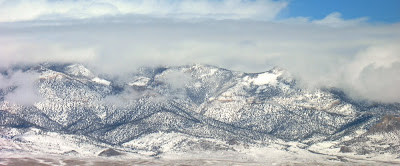
Snake Range, Nevada: a place to collect mylonites.
1. See a metamorphic core complex - metamorphic core complexes are common in a belt in North America, from British Columbia south into Mexico, and also occur in other places in the world, including Slovakia, Greece, Turkey, Iran, Tibet, China, and New Zealand. One should see a metamorphic core complex, preferably as part of a tour or field trip, just so one can get involved in the lively discussions about how they form, but also in order to see and collect wonderful samples of mylonites!2. While in Tibet, check out the Tibetan Plateau - just because it's there. It's the "largest, highest area in the world today" - and it was created by a magnificent convergence of two continental plates.
3. While in China, be sure to see the South China Karst, which is now a UNESCO World Heritage Site, and which contains some unusual rock formations formed by dissolution and re-precipitation of limestone: Guizhou Libo Karst, Yunnan Shilin Karst, and Chongqing Wulong Karst. I don't know of other similarly magnificent regions of karst that could replace this one.
Those are my three additions or suggestions. I have seen number one: several metamorphic core complexes in the western United States.
Accretionary Wedge #16: Is One Life Enough?
Saturday, January 17, 2009
LFD on 100 GeoBlog List
As noted by several other bloggers in the past few weeks, there is a new geoblog list - the 100 Best Blogs for Earth Science Scholars at this site - and Looking for Detachment is on it, along with - you guessed it! - 99 other earth science and geography blogs. [UPDATE 20Feb2013: I have been notified by email that the links in this 1st paragraph will be changing soon; the links, however, are still going through as of this date, so I am not removing them. Also, anyone could email me with that particular type of notification!]
One reason I bring this up is that I've not only noticed a few visitors coming here from the 100 Geoblog List, but I've also noticed a huge increase in traffic (visitors) from China. Apparently, this same list has been repeated on at least two Chinese-language sites, this one and this one. I know absolutely nothing about the first site, but the second one is part of the Chinese National Geographic Magazine site. I couldn't find this list on the primary National Geographic site, however. If anyone knows anything about the first Chinese site, please let me know. And if you are a visitor - geologist or not - from China, it would be great to hear from you!
UPDATE: I missed the main Chinese site, GeoIdea, which translated the 100 GeoBlog list into Chinese in the first place. GeoIdea was created by Hawkman and friends; Hawkman blogs here. Also, there are more listings for the Chinese Geoblogosphere at The Lost Geologist.
UPDATE AGAIN: And here is another Chinese site with the same 100 Geoblog list. It links to the Chinese National Geographic Magazine site, but as far as I can tell, doesn't list to GeoIdea.
One reason I bring this up is that I've not only noticed a few visitors coming here from the 100 Geoblog List, but I've also noticed a huge increase in traffic (visitors) from China. Apparently, this same list has been repeated on at least two Chinese-language sites, this one and this one. I know absolutely nothing about the first site, but the second one is part of the Chinese National Geographic Magazine site. I couldn't find this list on the primary National Geographic site, however. If anyone knows anything about the first Chinese site, please let me know. And if you are a visitor - geologist or not - from China, it would be great to hear from you!
UPDATE: I missed the main Chinese site, GeoIdea, which translated the 100 GeoBlog list into Chinese in the first place. GeoIdea was created by Hawkman and friends; Hawkman blogs here. Also, there are more listings for the Chinese Geoblogosphere at The Lost Geologist.
UPDATE AGAIN: And here is another Chinese site with the same 100 Geoblog list. It links to the Chinese National Geographic Magazine site, but as far as I can tell, doesn't list to GeoIdea.
Subscribe to:
Posts (Atom)