Thursday, November 26, 2009

A Bird - Or Two

While we are waiting for the bird in the oven to cook, we have been watching smaller birds discover our new birdfeeder, which hangs from a bungee cord over our wintertime garden. Here, I'm looking out our entryway window, spying on one of the first Juncos to find the feeder.
These birds act quite nervous about this new feeder - seems they are used to hiding in elm trees, and maybe aren't used to being so close to the ground while eating. Or maybe they just don't like being watched, or are aware of the many outdoor house cats that prowl the area.
A hungry Junco sticks it's head and beak inside the feeder...
...and comes out with a millet seed.

Happy Thanksgiving, everyone!

Monday, November 23, 2009

State of the Blog Re: Commenting

Just a quick update about the current state of comment moderation on LFD. I've been receiving more than the usual number of spam comments linking to advertising sites and such, so I have put all posts on comment moderation, not just the usual pre-14-day posts. I'll leave it this way until spammites (not psammites, one of my favorite rock types) taper off. I'm thinking that maybe spammers/bots have ramped up their activity for the holidays.

The Fine Print: Names that link to adverstisements and websites selling things, instead of the more usual profile or blog, are automatically considered spam and will not be published or, if accidentally published, will be deleted mercilessly. Comments that contain links to advertisements and websites selling things are also considered spam, even if the comment seems "friendly." Sign-in names like "Mr. Low Prices" are dead giveaways that you happen to be a spammer. I will not publish any comments under any circumstances that link to sites selling research papers. If you think I should mention your website, blog, or name on this website - AND YOU HAVEN'T EVEN BOTHERED TO LINK TO MINE - uh, WTF??

UPDATE: Comments are back to the usual, with moderation only on posts older than 15 days. This state of affairs is subject to change without warning when I'm traveling or when I have poor or intermittent internet connections.

Friday, November 20, 2009

One Year Ago Today: Bye Bye Trees

I'm a little late posting this one - three days to be precise - but am going ahead with it, and using the original publish date. My excuse? I was out of town without access to wifi.
It was exactly one year ago when these nefarious people came along and cut down the elm trees growing near our little house in the hinterland of eastern Nevada.
I was annoyed and saddened by this at the time, and blogged briefly about it last spring, when I showed what the now barren wall looked like in the before state.
It still looks barren out there to me.

Monday, November 16, 2009

Travel Day Four, Part #1: Multnomah Falls

drive When I left the GSA meeting in Portland, I decided to take a different route back, one that would normally be shorter, except for several sidetrips that I took. After figuring out how to get away from downtown Portland despite faulty Google Maps directions, I immediately headed east on I-84, which goes up the Columbia River. My first goal: stop at Multnomah Falls (Google Maps location), one of my favorite places. To that end, I got off the freeway and took the old road, the Historic Columbia River Highway, which goes by several falls.
fog The first view of the falls, from the parking lot area, made it seem as though it was coming out of the low-hanging clouds. Would I be able to see the entire falls?
bridge The upper and lower Multnomah Falls, and the footbridge, from a little ways in. The bridge - Benson Bridge - was built in 1914 by Simon Benson, an early emmigrant to Oregon.
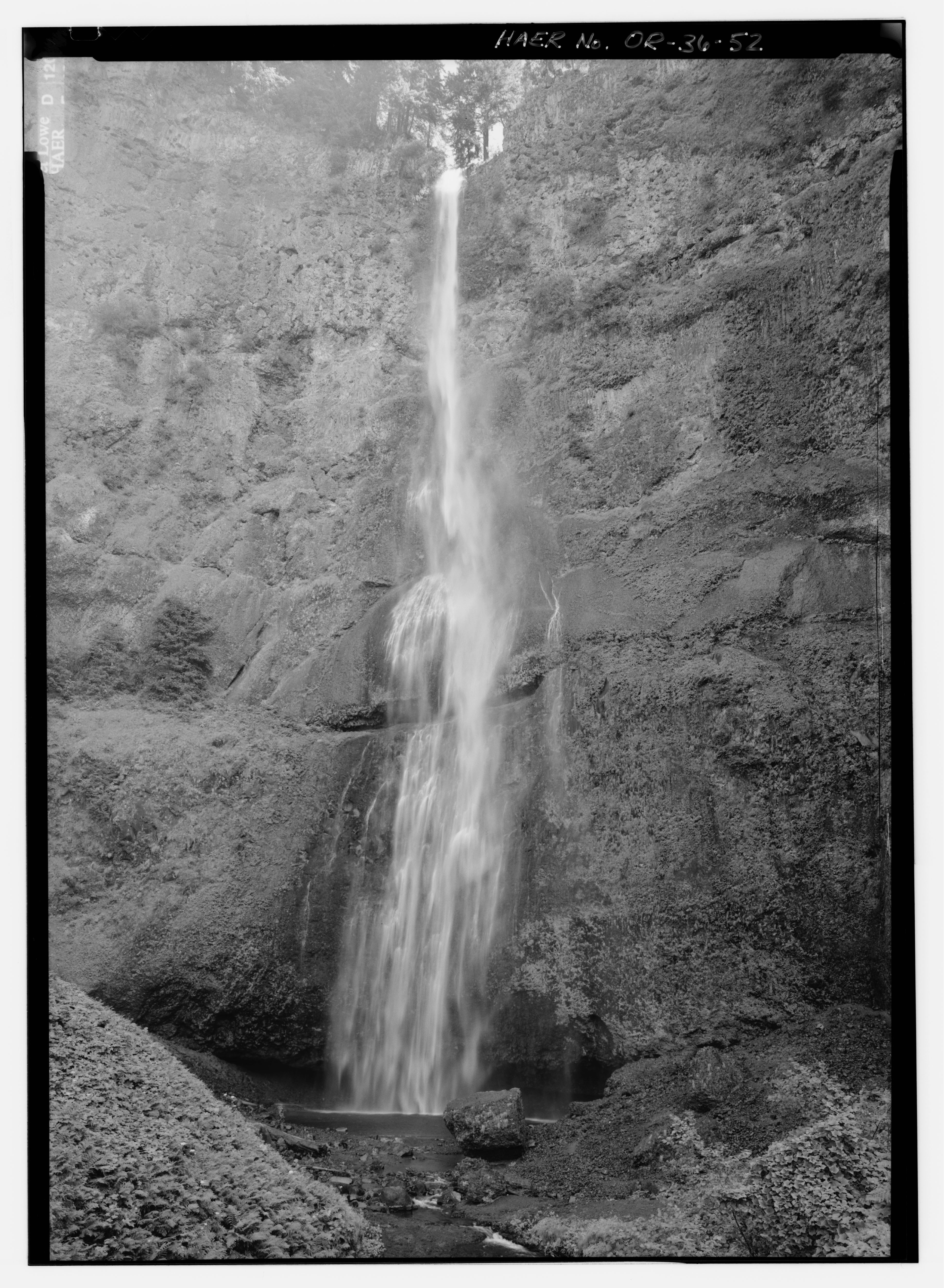
trees Multnomah Falls - the second highest year-round waterfall in the U.S. - flows over part of the Columbia River Basalt Group (CRBG), specifically five flows of the Grande Ronde Basalt, which is the lower part of the Yakima Subgroup of the CRBG (Mangan et al, 1986). Many of the online links I found say that six flows are exposed in the cliff face of the falls; from what I can tell from an original source, six flows of the Grande Ronde Basalt are exposed from the Columbia River to the top of the falls, with pillow lavas being at or just below the very top of the upper falls (Norman and Roloff. 2004). Norman and Roloff's strat section makes it look like there are five flows in the cliff faces of the uppper and lower Multnomah Falls. Anyway, check out their drawing and see what you think!
lower These are the lower falls, with Benson Bridge above and the upper falls above and behind the bridge.
path It's a moderately easy hike on this trail, through wonderful rainforest - see the ferns! - to the bridge.
sign At the bridge, this sign tells part of the story of a huge rock that came off the face behind the upper falls in 1995. The rest of the story is told here. The huge rock mass that fell off the cliff shattered when it hit the upper plunge pool, resulting in minor injuries to some people on the bridge. When I was there in late 2000, five years after the rockfall, the falls didn't look the way I remembered - from visits decades earlier and from photographs.
upper The entire upper falls. Can you tell where the rock fall came from? (It's shown on the sign.)
fracture Well, I'm thinking that the rock fell from the large diagonal fracture area just above the curvilinear, nearly horizontal fracture cutting across the entire lower part of the photo. I base this conclusion partly from memory, and partly from a July, 1995, photo on Wikimedia that shows a rock mass instead of a diagonally fractured area. Also, compare the full resolution version of the Wikimedia photo to Ron Schott's gigapan of Multnomah Falls, from August 6, 2009.
rock And one more thing before we look higher: the rock in the center foreground of this photo is not "the" rock that fell in 1995. For one thing, it's not large enough to be the bus-sized rock. For another thing, the mass that fell shattered into pieces upon hitting the ground. And besides that, this rock is present in old photos including the Wikimedia photo of July, 1995.
pillows This tan area near the top of the falls shows some interesting radiating to irregular columnar jointing in the basalt, just below some of the pillow lavas, which can be seen in the upper part of this photo (enlarge to see the pillows).
top And finally, here is a close-up view of the uppermost part of the upper falls, which was almost hidden in the low-hanging clouds. I've walked the trail to the top - once, I think - back in 1993. I highly recommend the trail just for the immersion into the rain forest. And there's a great view looking straight down the falls.
water Ooh, neat water near the bottom of the upper falls!
forest Another shot of the wonderful rainforest, this time on the way back toward the parking lot. Anyone who visits Multnomah Falls should consider eating in the historic Multnomah Falls Lodge, which was built in 1925. This time, I just stopped at an outdoor coffee and snack stand and got a hot chai tea to go.


Some References:
Mangan, M.T., Wright, T.L., Swanson, D.A., and Byerly, G.R., 1986, Regional correlation of Grande Ronde Basalt flows, Columbia River Basalt Group, Washington, Oregon, and Idaho: Geol. Soc. America Bulletin, v. 97, p. 1300-1318. [also see this Geoscience World link]

bonus1
Norman, D.K., and Roloff, J.M., 2004, A Self-Guided Tour of the Geology of the Columbia River Gorge—Portland Airport to Skamania Lodge, Stevenson, Washington: Washington Division of Geology and Earth Resources, Open File Report 2004-7.


UPDATE 4Jun2010: For a view of the basaltic rock types at Multnomah Falls see this post at Geology Blues.

Saturday, November 14, 2009

Late Night Ramblings: From Becke Lines to Mining Scams

Poetic. It's not that I'm feeling poetic, but that word came to mind, so I wrote it down.

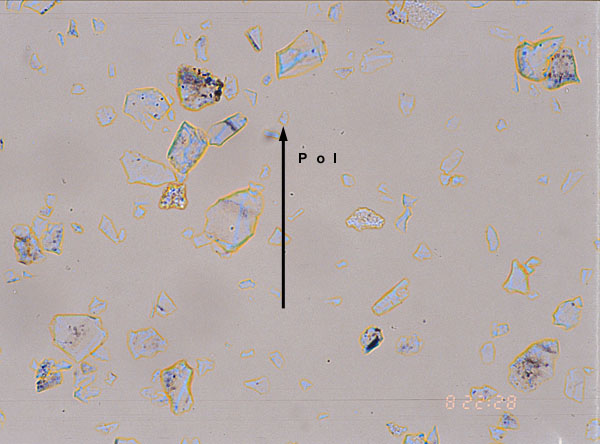
I've had the jimmy legs while trying to sleep, so I've opened the window a crack and am drinking a cold dPf while writing in my journal. I'm using a headlamp with a red LED - this has the odd effect of giving the shadow of my moving pen a deep turquoise line on the left side (toward the light) and a deep red line on the right side (away from the light and more or less behind my hand). These colors, and their arrangement around the edges of my pen and hand, remind me first of Becke lines, which surround mineral grains immersed in oils or epoxy media. Then - especially when I turn the pages of this spiral journal - they remind me of 3-D glasses, as if I've somehow entered some supra-dimensional movie. I haven't, though, I'm just writing and wondering where the one-day-late snow is, and whether I have the window cracked too far open for comfort.

(The deep turquoise and deep red lines - which may entirely be optical effects inside my eyes, as I can only see them when the pen shadow or journal moves - has the effect of making this red-lit white paper appear pink to orange to occasionally yellow. It's as though my eyes are trying to convince my brain that I'm using ordinary incandescent lighting.)

And that reminds me - didn't some country just recently outlaw incandescent bulbs? (Actually, several have.) If only the other bulbs worked consistently. I try to buy the most expensive ones in hopes that they will turn out to be the best ones. Hopefully there is enough "byproduct"mercury from the gold mines of the world so we won't have to go back to mining mercury at mercury mines - such as the ones in Spain and Slovenia (Almadén, Idrija) and the ones in the Coast Ranges of California (New Almadén, New Idria). Seeing liquid mercury drip from old trench and pit exposures is something I'd rather not see every day. And, likewise, running across old-looking but still-in-use jars of mercury used for gold extraction by old-timers - whether in some out-of-the-way prospect north of Napa Valley or down some dusty dirt road in the Mojave Desert - is not something I like to come upon unawares or unexpectedly.

The old-timers in question (some of them are still around, perhaps?) are always quite casual about showing you their gold-rich mercury, and they are equally casual about showing you their dusty, disorganized assay labs out in the middle of nowhere. Jars, bottles, and tools of all sorts are scattered on old wooden work benches built against walls - these are their lab tables. From one etched, north-facing window, you have a nice view of the creosote desert and rocky granitic mountains. Want to have lunch in here? (I think not.) And is that an ice chest I see over near the doorway to the main cabin? Yes, the garage-shed assay-lab is attached to the living area of this old field shack. Too many rusted and broken parts, too much dust, and too many old and unknown lab chemicals are lying around loose.

Where did you say you're getting the gold from? Those pinkish brown, fractured granites over there, the ones with the narrow seams of goethitic iron-oxides in either brown carbonate or microcrystalline silica? Veins, you call them? I think I'd be being generous if I called them veinlets. Okay, we'll high-grade just those tiny veinlets, and then we'll see. We'll get back to you after our commercial lab does its thing. (No, you can't do the assays for us. We're already thinking that you got the gold the same place you bought the mercury - maybe in some old Mother Lode mining town?) Maybe we'll be back, and maybe we won't - but no, we won't be looking at your lab anymore, no matter how proud you are of it.

Not to be disparaging about your claims, but though the ankeritic-goethitic veinlets are interesting, they look too narrow and mostly too far apart to be likely to carry the barren granite they're cutting. (Although it's true, they could indicate something at depth, or something underneath that shallow alluvium just over there, right off your claims. But don't worry, we'll still want to lease your claims - if there is anything we want to come back to after we see some real assay numbers.)

(Besides which, old Joe up the road apiece - quite apiece at that - warned us that you were running some kind of scam down here. But maybe he just wants us to lease his claims, not yours. So, we'll see.)

And who was I with, down there in the east-central Mojave? Seems it was in the same area where a small gold mine was operating - the mine that routinely over-loaded their blast holes such that the metal roof of their mine office had dents and holes from large rocks that fell out of the sky every day, rocks blasted out of their small open pit. We ate lunch near the buses, that field trip day, then drove an entire mile away to avoid the coming bombardment.

I don't know what year it was. The location suggests to me that I was there with either PB or NJ - although the sampling part could have been a joint effort with BS and an assistant of his - except I don't think we worked that area with double partners. So the answer may be forever lost in the dirt and dust of that messy lab or in the steep and rocky slopes two canyons over.

Could I find that mine shack again? Maybe. I have a geographic location tucked firmly away in my head - it's a little SSW of that small gold mine, down some wide southerly-heading dirt road, generally SE of that broad, alluvial-choked peak, and in some vague area between or amongst two north-south-trending ranges. Besides which, unless it was on a tiny piece of private land, it's probably gone.

From 12Nov09, 9:33pm