
Wednesday, August 10, 2011


Monday, August 8, 2011
Fishing for Reds and Other Miscellany (including a Volcano): AK2011 Days 5-7
 We spent a good deal of our Kenai cabin days standing in the river fishing for reds (Sockeye salmon), hip high in the water, sometimes soaking wet from our first day's leaky boots, sometimes not quite as wet from enthusiastically getting in a little too far. I really don't have many pictures of these operations; I was too busy standing in the river fishing, catching and not catching, throwing back "foul caught" reds*, and hauling in the one keeper. Also, I didn't have a waterproof camera.
 One day, we walked a trail down to a part of the river that turned out to be not very far away had we walked along the bank (not possible), and fortunately, in my opinion, we didn't see any bears or come upon any unsuspecting moose on this walk. Instead, we saw a juvenile bald eagle flying overhead, and saw an adult bald eagle being hassled by a gull.
Those were two of the only four bald eagles we saw the entire trip, which seemed unusual to me, but apparently that's because I'm used to being on the Kenai during silver season in late August. The bald eagles really move in after spawned-out reds and kings start dying and floating downriver and onto the beaches, which means there are a lot more bald eagles to be seen in late August (along with a lot more dead fish and "floaters").
 We ate salmon that we caught, we went to St. Elias Brewery, we went back to Buckets — where two of us were left behind by the other two, to be picked up almost immediately upon being spotted hitchhiking down on the main drag just below Buckets. That's the errant vehicle beyond and behind the Buckets sign, returning for my mom and me. Fun for the Family! :)
 And we picked up a needed part for the boat, where I saw a wonderfully pink drill rig.
 We also took a trip to the other side of the river, which involved driving a long way to a bridge and then driving a long way through the trees, coming finally to unmarked dirt roads. Our goal was ultimately unobtainable, so we made the long trip back. Our reward was this veiw of Mt. Redoubt, as seen from the airport runway in Soldotna (Redoubt activity and webcams).
And then down to Homer on the 8th day...
---
*Reds can only be caught by being hooked in the mouth, and they typically aren't biters, although they sometimes bite the wet flies on the bottom of the river in irritation, it is said, or maybe just because their mouth was open and the fly drifted in (!?). Consequently, reds are sometimes caught after being "snagged" legally in the mouth -- there is such a thing as illegal snagging, that is, you are *trying* to snag by using a "snagging motion" -- and many fish are accidentally snagged in fins and tails; those have to be returned to the river. I got one possible catch almost all the way to shore, not being able to tell whether it was hooked in the mouth or chin, before it unhooked itself. I unhooked at least one fish I brought all the way in. I'm not sure how many catches that got away from not being hooked well enough would have been keepers. (My poor fishing excuses for only getting one fish.)
Location:
Buckets, Soldotna, AK, USA
Friday, August 5, 2011
A Few Questions (and some Answers)
What do you do when hard rock geologists are hard to come by (as was the case when geological hiring was making a comeback in the early 2000s after the gold crash of 1997-98?
Normally, a lack of geologists with a required experience level or orientation toward mining, exploration, mineralogy, etc. has resulted in an across-the-board increase in pay for geologists in the industry.
Related Thought: Experienced hard rock geologists aren't necessarily hard to come by at the moment, but everyone I know is pretty busy.
One thing that can be done when geologists are hard to find is to increase recruiting efforts at schools that support mineralogy, petrology, geochemistry, and field camp. If you teach at such a school, you should make sure the industry knows that your school falls into that category. Some companies currently recruit, at least in part, outside the U.S.
Companies can advertise jobs where they will be seen: at schools supporting required classes and at geological societies geared towards mining and exploration such as the Geological Society of Nevada (GSN). Many companies routinely do the latter, and I get emails with the resulting job postings.
An Aside: More basic training is probably offered by some companies now than at any time in the recent past, although documentation of this supposition of mine is sparse. Training geologists to recognize common minerals and rock types should not be necessary. Training geologists to recognize uncommon minerals associated with common ore deposit types has, perhaps, beome more common through the years; many of these types of minerals used to be learned in ore petrography, in economic geology and mineral exploration classes, and in grad school. With the industry booming, many young geologists are bypassing grad school for jobs available now (a practise which is being recommended and supported by many companies). In my early days, it was fairly routine to be sent out to your first drill rig without any, or much of any, introduction to drilling, sampling on rigs, contamination problems, what to think if the driller says X, what to do if the driller says Y, when or how to tell them to shut it down (for a variety of reasons, such as poor sampling, drinking on the job, not showing up at the rig...), and many other things that I mostly just picked up on my own.
What do you do if your contacts in the hard rock world happen to be minimal or out of date (as mine were in the late 1990s and early 2000s)?
You go to places where hard rockers hang out, such as meetings of the GSN or AGS (Arizona Geological Society) or other state geological societies, field trips run by the GSN twice yearly, field trips run by the SEG (Society of Economic Geologists) every year at GSA, conventions offered every five years by the GSN and yearly by the NWMA (Northwest Mining Association), and you take short courses as necessary. In other words, you update or re-create your contact base. This may or may not take much effort, depending on a variety of variables.
What do you do if you happen to be unwilling to pay the going rate for experienced geologists or less experienced geologists with hard rock degrees (as happened to me in the late 1980s)?
A lot of times, you end up doing the work yourself or end up doing less work per time period—in other words, you suffer. If you hire less experienced people or those with an inadequate background (as I have had to do on occasion because of company hiring policies), you get less done, sometimes spending nearly the same amount as if you had paid a higher rate, depending on your overhead. And you kick yourself a couple times while complaining vehemently to your boss about the company pay rates. There is no real fix to this latter situation, except time and hopefully a management willing to buck the trend or status quo. (Your company may get bought or spun off, thus possibly fixing the management problem, as also happened in the late 1980s and probably also at other times.)
How long does it take to train inexperienced geologists to do the tasks at hand?
This really depends on what you need to have done. For a jasperoid-sampling program down ridgelines in Nevada, training time is minimal, perhaps a few days, at most a week if you also need to teach field location skills (GPS should make this considerably easier than in the past—though map-reading skills should still be required, in case the satellites go down or in case your batteries go dead or you drop your GPS in the water or over some cliff), maybe a day or two more to teach 4WD skills (use a helicopter instead!). If you want detailed rock descriptions or unusual mineralogical determinations (by geologists rather than by x-ray) in somewhat complicated alteration assemblages, for example in IOCG deposits and skarns (iron oxide-copper-gold) or in high and low sulfidation gold-copper systems you had better plan on two weeks minimum (often even with experienced geologists) depending on background and mineralogical aptitude—also, consider sending your geologists on an intensive mineralogy or alteration short course or an appropriate field trip. And, be sure to hire geologists with good observation skills! Always!!
As a just-out-of-school geologist, how should I go about getting a job in mineral exploration and mining?
Here, my ideas are possibly somewhat out of date, but see question number two about creating contacts, elicit help from your professors who are hopefully maintaining some contacts, and contact major and some minor exploration/mining companies.
Consider traveling to mining-oriented states like Nevada if you get some encouragement or just to knock on doors; this may not be done as often as it used to be, but I suspect it would still be considered a sign of initiative.
Sign up for the GSN so you'll get job announcements (not just for Nevada). Although many of these postings will be for people with at least some minimal years of experience, you may be able to apply for some of those jobs, and you will get names of people to contact. Also, jobs for entry-level geologists are advertised through these emails; I got one of these as recently as late May.
Other ideas that work are welcome.
Normally, a lack of geologists with a required experience level or orientation toward mining, exploration, mineralogy, etc. has resulted in an across-the-board increase in pay for geologists in the industry.
Related Thought: Experienced hard rock geologists aren't necessarily hard to come by at the moment, but everyone I know is pretty busy.
One thing that can be done when geologists are hard to find is to increase recruiting efforts at schools that support mineralogy, petrology, geochemistry, and field camp. If you teach at such a school, you should make sure the industry knows that your school falls into that category. Some companies currently recruit, at least in part, outside the U.S.
Companies can advertise jobs where they will be seen: at schools supporting required classes and at geological societies geared towards mining and exploration such as the Geological Society of Nevada (GSN). Many companies routinely do the latter, and I get emails with the resulting job postings.
An Aside: More basic training is probably offered by some companies now than at any time in the recent past, although documentation of this supposition of mine is sparse. Training geologists to recognize common minerals and rock types should not be necessary. Training geologists to recognize uncommon minerals associated with common ore deposit types has, perhaps, beome more common through the years; many of these types of minerals used to be learned in ore petrography, in economic geology and mineral exploration classes, and in grad school. With the industry booming, many young geologists are bypassing grad school for jobs available now (a practise which is being recommended and supported by many companies). In my early days, it was fairly routine to be sent out to your first drill rig without any, or much of any, introduction to drilling, sampling on rigs, contamination problems, what to think if the driller says X, what to do if the driller says Y, when or how to tell them to shut it down (for a variety of reasons, such as poor sampling, drinking on the job, not showing up at the rig...), and many other things that I mostly just picked up on my own.
What do you do if your contacts in the hard rock world happen to be minimal or out of date (as mine were in the late 1990s and early 2000s)?
You go to places where hard rockers hang out, such as meetings of the GSN or AGS (Arizona Geological Society) or other state geological societies, field trips run by the GSN twice yearly, field trips run by the SEG (Society of Economic Geologists) every year at GSA, conventions offered every five years by the GSN and yearly by the NWMA (Northwest Mining Association), and you take short courses as necessary. In other words, you update or re-create your contact base. This may or may not take much effort, depending on a variety of variables.
What do you do if you happen to be unwilling to pay the going rate for experienced geologists or less experienced geologists with hard rock degrees (as happened to me in the late 1980s)?
A lot of times, you end up doing the work yourself or end up doing less work per time period—in other words, you suffer. If you hire less experienced people or those with an inadequate background (as I have had to do on occasion because of company hiring policies), you get less done, sometimes spending nearly the same amount as if you had paid a higher rate, depending on your overhead. And you kick yourself a couple times while complaining vehemently to your boss about the company pay rates. There is no real fix to this latter situation, except time and hopefully a management willing to buck the trend or status quo. (Your company may get bought or spun off, thus possibly fixing the management problem, as also happened in the late 1980s and probably also at other times.)
How long does it take to train inexperienced geologists to do the tasks at hand?
This really depends on what you need to have done. For a jasperoid-sampling program down ridgelines in Nevada, training time is minimal, perhaps a few days, at most a week if you also need to teach field location skills (GPS should make this considerably easier than in the past—though map-reading skills should still be required, in case the satellites go down or in case your batteries go dead or you drop your GPS in the water or over some cliff), maybe a day or two more to teach 4WD skills (use a helicopter instead!). If you want detailed rock descriptions or unusual mineralogical determinations (by geologists rather than by x-ray) in somewhat complicated alteration assemblages, for example in IOCG deposits and skarns (iron oxide-copper-gold) or in high and low sulfidation gold-copper systems you had better plan on two weeks minimum (often even with experienced geologists) depending on background and mineralogical aptitude—also, consider sending your geologists on an intensive mineralogy or alteration short course or an appropriate field trip. And, be sure to hire geologists with good observation skills! Always!!
As a just-out-of-school geologist, how should I go about getting a job in mineral exploration and mining?
Here, my ideas are possibly somewhat out of date, but see question number two about creating contacts, elicit help from your professors who are hopefully maintaining some contacts, and contact major and some minor exploration/mining companies.
Consider traveling to mining-oriented states like Nevada if you get some encouragement or just to knock on doors; this may not be done as often as it used to be, but I suspect it would still be considered a sign of initiative.
Sign up for the GSN so you'll get job announcements (not just for Nevada). Although many of these postings will be for people with at least some minimal years of experience, you may be able to apply for some of those jobs, and you will get names of people to contact. Also, jobs for entry-level geologists are advertised through these emails; I got one of these as recently as late May.
Other ideas that work are welcome.
Wednesday, August 3, 2011
At the Cabin: AK2011 Day 4
 After dinner and beer at Buckets, we made our way back to the cabin, which we hadn't stayed in for three years. The canal looked about the same as it did in 2008, possibly with a few more moose-munched cottonwood trees growing here and there along the bank.
We walked around and looked at the sights:

Boats.

Reflections from boats and cabins.

Float planes and more reflections.

Old, licheny docks and fish-cleaning tables.

More float planes, this one roaring by to land upriver.
 After the seaplane landed, it taxied up the canal to pull in and tie up. While we were there, several float planes came to stay near the canal by the cabin; I counted as many as four at once, maybe five. These are quite popular for hieing down to the river when the reds come running in large numbers, as they had a couple days prior to our arrival on the Kenai. The sockeye surge was just beginning to come into the upper river, and fish-cleaning operations were going on all around us. People typically have tables right along the river or canalside; some fishermen and fisherwomen bring portable cleaning tables over to the river from their off-river cabins.
 We decided to go for a walk, to check out a fishing spot I knew we could use (if we could just figure out how to put wet flies on rods for the reds or could find any non-leaky hip waders).
Sights seen along the way:

Leaves, twigs, and dried spruce needles.

Cotton from cottonwood trees, on what looks like gravel from graywacke.

Miscellaneous cabinish junk and Alaskana, including this scenic (IMO) old pickup.

Fishing related decorations: old floats.

Fishing-related decorations on cabins, garages, and carports.
 We did make it down to the fishing hole, decided to wait for further instructions from the fisher-people arriving the next day, a day that would be dedicated to fishing, getting new hip waders, and eating dinner at the St. Elias Brewery.
Monday, August 1, 2011
Down to the Kenai: AK2011 Day 4

Looking across the Turnagain Arm fjord at our general destination, the Kenai Penninsula, that flat area west of the edge of the Kenai Mountains.
It is in the usual order of things for us to make our way down to the cabin as soon as possible after arriving in Alaska, sometimes heading out as early as the first or second day. This time, we drove down on the fourth day.
It is also in the usual order of things for everyone to travel in one vehicle, but this time we took two: the truck needed to get to the cabin so it could be in a position to conduct cabiny things like putting the boat in the water.
 Hard to tell for sure with the clouds, but this is most likely Mt. Spurr (MSRMaps), a volcano west of Anchorage and across Cook Inlet (AVO Webcam). It last erupted in 1992.
We made our way eastward down Turnagain Arm on AK State Route 1, the Seward Highway, without making the usual stops at Beluga Point to check the tides or at Girdwood to get coffee. We speculated about the tides, and whereas I thought the tide was possibly going out, the wind was very strong, creating huge easterly waves that obscurred the water motion. The tide books indicated that the tide was either almost all the way in, or just starting to go out, but I didn't try hard to parse the time differences between Kenai and Anchorage and then to translate those times to the arm.
I looked for Beluga whales, but it was early in the summer: they follow the fish, especially the silvers and humpies of August. It was only the late run of July reds that was just beginning to come up the arm; I looked for Belugas nonetheless.
 The light on the water of the arm is always fascinating to me. Here it's flickering in thin patches just below the last major valley on the south side of the arm, Seattle Creek.
 I seem to photograph the valley of Seattle Creek every time I pass through: it's a great example of a U-shaped valley carved by a glacier that once entered into the larger glacier that carved Turnagain Arm.
 We passed the turnoff and viewing area for Portage Glacier near Portage and made the turn at the east end of Turnagain Arm. Crossing the second bridge across the Placer River — a river typical of anastomosing rivers and streams coming off ice fields and glaciers, in this case the Spencer Glacier and a small icefield northwest of the larger Sargent Icefield — I could look northward up the Placer into the valley of the Twentymile and Glacier Rivers (MSRMaps).
Welcome to the Kenai!
 The fireweed was in relatively early bloom: when the flowers at the top are blooming it indicates that fall and Termination Dust are just around the corner. Here, only the lower flowers are blooming.
We skipped a usual stop at Summit Lake Lodge in favor of continuing onward to the Sterling Highway (still AK Route 1, but no longer the Seward Highway).
 Near Cooper Landing we began to catch tantalizing glimpses of the Kenai River, a river we would soon fish.
 We bypassed the cabin, needing to run to town to purchase fishing licenses, thereafter going directly to Buckets for dinner.
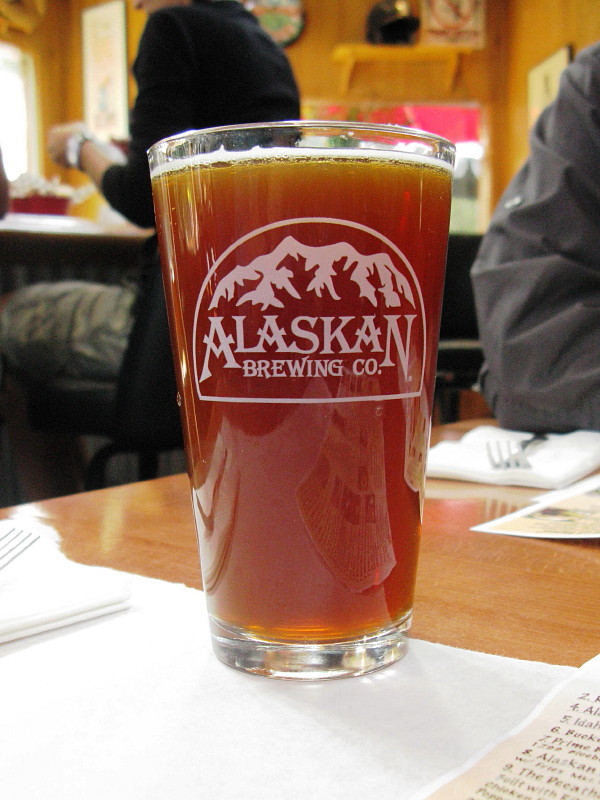 We both had the Sunken Island IPA by Kenai River Brewing.
Related Posts:
Getting There: AK2008 Day 1
Turnagain Arm: AK2008 Day 2
We Make the Turn: AK2008 Day 2
Summit Lake and Beyond: AK2008 Day 2
Fireweed in Alaska: Is it Fall?
Location:
Kenai Peninsula, AK, USA
Subscribe to:
Posts (Atom)